


PPC, or pay-per-click, is online advertising where you pay only when someone clicks your ad, not when it shows. You bid on the terms your customers type into Google, your ad appears above the results, and the charge lands on the click, never the view.
We run these accounts every day, and the same story turns up across UK businesses. Money goes in, clicks come back, and three weeks later, the spreadsheet still shows no profit. A London taxi firm came to us paying £10 to £12 for every booking. The platform wasn’t broken. The account was, and within two weeks, the same spend was producing bookings at £3.09 each.
Most “what is PPC” guides stop at the definition and a list of ad types. This one goes where the money actually moves: why campaigns lose money in the first month, what decides whether they recover, and what a UK click really costs in 2025. It’s written from the side of the account, not the textbook.
TL;DR:
PPC puts your ad in front of people already searching for what you sell, and you pay per click. It works, but rarely on day one. Budget for a 60-to-90-day learning period, get your account structure and tracking right, and the same money that bleeds for beginners starts to compound into sales.
What Is PPC and Where Do Your Ads Appear?
PPC charges you for attention, not exposure. Search “emergency plumber Manchester” and the top results carrying a small “Sponsored” label are PPC ads, and each business behind them pays only if you click.
The same pay-per-click model runs across Google Search, its partner sites, Shopping listings, YouTube, and social feeds. Because you pay for the click and not the view, every pound chases people who are already looking. That’s what makes PPC one of the fastest ways to put qualified visitors in front of your offer.
Where Your Ads Can Appear
For most businesses, search is the place to start, because it catches people at the moment they’re actively looking. On a commercial search, paid listings sit above the organic results and take the first thing a buyer sees, so intent on search runs higher than on any other format. That’s why search campaigns often deliver the fastest route to qualified leads.
Paid visibility is also moving into new ground. Google has begun showing ads inside AI Overviews and AI Mode, the AI generated answers now appearing at the top of many searches, which changes where the first impression happens. If that shift matters to your business, our guide on optimising for AI search covers it in depth.
How Does PPC Advertising Actually Work?
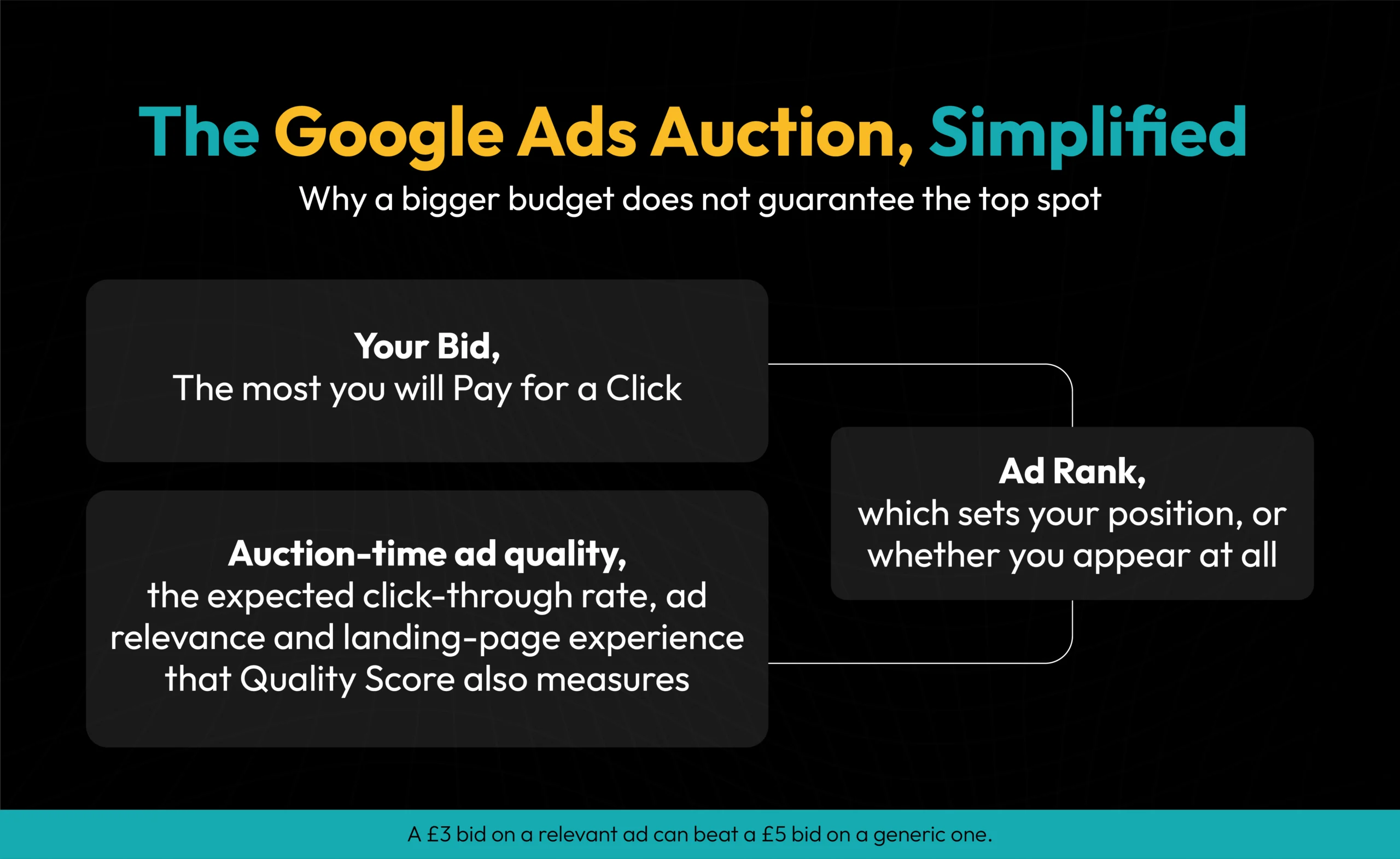
Every search sets off an auction that Google settles in roughly the time the page takes to load. Two things decide the outcome: your bid, which is the most you’ll pay for a click, and the quality of your ad and landing page at that moment. Google combines them into your Ad Rank, which sets your position. It’s why a plumber bidding £3 on a tightly relevant ad can sit above a rival bidding £5 on a generic one.
PPC rewards quality as much as spending power. That’s one reason some businesses get strong results on modest budgets while others struggle spending far more.
Quality Score and Why It Lowers Your Costs
Quality Score is the lever most beginners never touch, and it’s the cheapest one in the account. It’s Google’s 1 to 10 read on three things: your expected click-through rate, your ad relevance, and your landing-page experience.
Raise those and two things happen at once. Your ad climbs, and your cost per click falls, because Google rewards relevance. The same click that costs a sloppy advertiser £4 can cost a relevant one £2. Sharpening the ad and the landing page beats throwing more money at your bid almost every time.
The Four Metrics That Actually Matter
Four numbers carry the account. Each one is useful, and each one misleads if you read it alone.
- CPC (cost per click): useful for budgeting, weak as a measure of success on its own.
- CTR (click-through rate): signals that your ad is relevant, but a high CTR that never converts is just expensive attention.
- Conversion rate: the real test of whether the click becomes a customer.
- ROAS (return on ad spend): the one number that tells you the account makes money.
Watch conversion rate and ROAS hardest. A 50p click means nothing if it never buys, and judging a campaign on clicks alone is how budgets disappear.
The Main Types of PPC Ads
PPC isn’t one format but five, and each earns its place at a different stage of intent. Search captures demand that already exists and carries the highest intent, which is also why it’s the most competitive. Shopping suits retail with a product feed, putting price and image in front of the buyer.
Display buys cheap reach and is weak on intent, which is why it works best as the canvas for remarketing. Social finds people by interest before they search, so it generates demand rather than capturing it. Remarketing is usually the cheapest re-engagement you can buy, because it speaks to people who already know you. Most businesses start with search and add the rest as the numbers justify it.
| Ad type | Where it appears | The practitioner’s read |
|---|---|---|
| Search | Top of Google or Bing results for a query | Highest intent, the first place to spend, the most competitive |
| Shopping | Product listings with image, price and retailer | Built for retail with a clean product feed |
| Display | Banner ads across partner sites and apps | Cheap reach, low intent, best used for remarketing |
| Social | Feeds on Meta, LinkedIn, TikTok and similar | Interest-based discovery, generates demand more than it captures it |
| Remarketing | Ads shown to people who already visited you | Usually the cheapest re-engagement and the highest return per pound |
If you sell physical products, e-commerce campaigns built on a clean shopping feed tend to earn their place earliest.
PPC vs SEO: Which Should You Choose?
This is rarely a choice, because the two do different jobs on different clocks. SEO is slow money. It takes months to build, then keeps paying after the work stops. PPC is fast money. It buys visibility the day you launch and stops the day the budget runs dry.
The two aren’t rivals so much as a sequence. On commercial searches, paid listings now sit above the organic results and take the first click a buyer sees, so the question is rarely whether to use PPC, but when. If you want the full picture on the slow-money side, our guide on how SEO works for your business sits alongside this one.
When to Lean on Each
Lean on PPC when your site is new and has little search authority, when you need leads this month, or when you want to test an offer without waiting, since it puts you in front of buyers within days and quickly shows which keywords and messages convert. Lean on SEO service when your margins are tight, your sales cycle is long, or you want traffic that doesn’t vanish the moment you pause spending. Most growing businesses run both: PPC to capture demand today, SEO to build reach for tomorrow.
How to Set a PPC Budget in 2026?
There’s no fixed price for PPC. You set the budget, and the market sets the cost.
In 2025, the average UK cost per lead came in around £70 across industries, but that average hides a wide spread. A click in travel or hospitality can run £1.50 to £2.50, while a law firm bidding on “conveyancing solicitor” can pay £6 to £9 or more, and Greater London adds another 15 to 30 percent on top of national rates. Treat those as a marker, not a promise, and judge your account on its own cost of a sale.
The bigger story is the direction of travel. Clicks have grown steadily more expensive year on year, which means wasted spend costs more than it used to, and a loose account leaks faster than it did even two years ago.
Setting a Starting Budget
Many businesses start by asking how much they should spend. A better question is what a customer is worth. Work backwards from the value of a customer and what you can afford to pay to win one, then size the spend to match.
As a current reference, the 2025 UK average conversion rate sits around 7.5 percent, though it swings hard by sector, from roughly 2.5 percent in finance and insurance to about 14 percent in motor repair. Use it as a marker, not a target. Judge a campaign on the cost of a sale: a 40p click that never buys is dearer than a £4 click that does.
Why Cheap Clicks Are Often the Wrong Goal
It’s tempting to chase a lower cost per click. On the surface, it looks like progress. The problem is that cheap clicks aren’t always valuable clicks. A visitor searching with strong buying intent often costs more than someone who’s only researching, and that more expensive click is usually the better investment. The goal isn’t the cheapest traffic. It’s profitable customers, which is why strong campaigns watch conversion costs and return on ad spend, not click costs alone.
How Long Before PPC Boosts Your Sales?
The most expensive mistake in PPC is quitting too early.
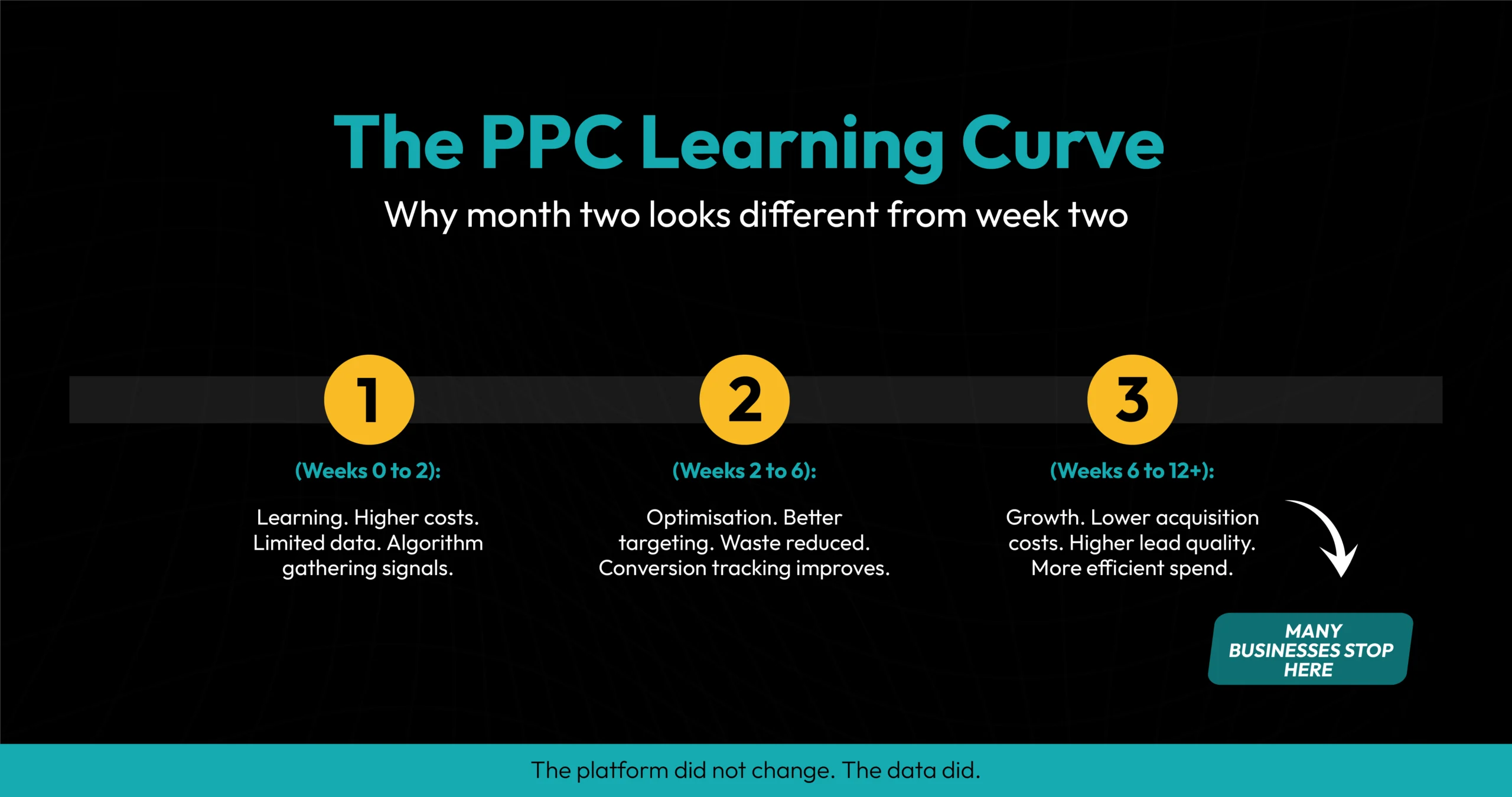
PPC is often expected to deliver instant profit, but the first few weeks are mainly a learning phase. The platform is still collecting data, working out which audiences, keywords, ads, and landing pages actually convert. Early performance can look inconsistent, and that doesn’t mean the campaign isn’t working. It means it’s still optimising.
What the Learning Phase Looks Like
Two things learn at once. Google’s bidding needs conversion data before it can get smarter, and so do you. Until the clicks add up, you can’t see which keywords deserve more budget, which ads to fix, or which traffic to cut.
That has a floor built into the platform. Google’s own guidance on its learning period describes roughly two weeks after each significant change, and up to about 50 conversions or three conversion cycles before a bid strategy settles. Stack those cycles together and most accounts need 60 to 90 days before performance becomes predictable. The figure isn’t a number we picked. It’s what the platform’s own mechanics produce.
Where Many Businesses Go Wrong
This is where many campaigns fail. You launch, check the numbers after a few weeks, see a high cost per lead, and decide the platform doesn’t work. The campaign gets paused. The data collection stops, and the next launch starts the learning over from zero. In a lot of cases, the business walked away the week before performance was about to turn.
The Businesses That Succeed Think Differently
The advertisers who win don’t expect perfection in the first few weeks. They expect to learn. That early budget isn’t only buying clicks, it’s buying information about what works, what doesn’t, and where the next pound should go. The campaigns that perform best over time are usually the ones that stayed live long enough to collect that information and act on it.
The Four Mistakes That Drain PPC Budgets, and How to Fix Them
Whether your spend compounds or drains away comes down to four fundamentals, and not one of them is the platform you picked. Each is easiest to understand as a common mistake and its fix.
- Mistake: broad, mixed-intent campaigns that chase every keyword at once.
Fix: tight ad groups matched to the exact search.
- Mistake: tracking clicks or raw form fills instead of real outcomes.
Fix: measure qualified leads and sales, so the bidding optimises towards money.
- Mistake: sending every click to the homepage.
Fix: match the landing page to the ad’s promise, which also lifts Quality Score.
- Mistake: setting the account live and leaving it alone.
Fix: review the search terms, cut the waste and test new copy every week.
How Structure and Quality Turn PPC Spend into Sales
When a campaign underperforms, the instinct is to add budget. That only works if the account is already working. If it’s pulling the wrong traffic, more spend just buys you a bigger version of the same problem. Two of our own campaigns show the difference.
A UK Taxi Company: Reducing Cost Per Booking by Around 70%
A local UK taxi company came to us spending on Google Ads but getting very few bookings. Cost per booking sat between £10 and £12, the account was catching irrelevant searches, and too much budget went on traffic that never converted.
The fix wasn’t a bigger budget. We rebuilt the account around high-intent booking keywords, expanded the negative keywords, improved ad relevance, and tightened the landing-page journey. Within roughly two weeks, cost per acquisition fell to as low as £3.09, click-through rate reached 10.27%, and one campaign converted at around 21%. A scaled version went on to generate more than 70 bookings at an average of £4.80 each.
A Canadian Accounting Firm: Building Performance from Zero
The second campaign started from nothing. A newly launched accounting and taxation firm had no campaign history and no audience data, so instead of expecting instant sales, we built the campaign to collect useful conversion data while targeting people actively searching for accounting services. It produced 306 qualified leads, more than 563,000 impressions, and a conversion rate of around 10%, plus the performance data the firm needed to grow.
A similar approach worked for a UK immigration consultancy that moved from Meta to Google Search. It generated 358 leads in the first month, about 75% of them qualified, at an average cost per lead near £7.49. The numbers differ by industry, but the principle holds: strong structure, accurate tracking, and steady optimisation beat simply spending more.
Should You Run PPC In-House or Hire an Agency?
It depends on who manages the account. Launching a campaign is the easy part. The ongoing work is what takes time: reviewing search terms, cutting poor keywords, testing ads, improving landing pages, checking conversion tracking, and shifting budget towards what’s producing leads.
That work doesn’t stop after launch. A business with an experienced in-house marketer often handles PPC internally because the skills and the time are already there. Many smaller businesses don’t have either.
Someone has to review the account every week and act on what the data shows. That, far more than any platform secret, is what makes PPC profitable. So, ask one question: who reviews your account every week? If you have a clear answer, in-house can work well. If you don’t, Talk to a PPC specialist will show exactly where budget is being wasted, which campaigns are driving results, and what to change next.
Need Help With PPC?
The difference between a profitable PPC campaign and an expensive one is rarely the platform. It’s the setup, the tracking, and the decisions made after launch. If you’d like a clear read on where your budget is going, get a free PPC audit and we’ll show you exactly where it’s being wasted and what to change.
FAQs
What does PPC stand for?
PPC stands for pay-per-click. It’s a form of digital advertising where you pay only when someone clicks your ad. Instead of paying for your ad to be shown, you pay when a visitor acts and lands on your website.
What is the minimum budget for PPC?
There’s no fixed minimum. The right budget depends on your industry, competition, and customer value. It needs to be large enough to generate meaningful data and enough conversions to optimise on. A budget that produces only a handful of clicks a month makes performance very hard to judge.
How long does PPC take to produce results?
Traffic can start the day a campaign goes live. Profitable, consistent results usually take longer. Most campaigns go through a learning period while data is collected and optimisation takes place, and for many UK businesses meaningful improvement appears over the first 60 to 90 days.
What are the most common PPC mistakes?
The most common ones are broad, mixed-intent campaigns, tracking clicks instead of real sales, sending every click to the homepage, and setting an account live then leaving it alone. A fifth, quitting before the 60 to 90 day learning period is over, is the most expensive of all. Each is fixable with tighter structure, better tracking, and weekly review.
What is the difference between CPC and CPM?
CPC stands for cost per click, so you pay when someone clicks your ad. CPM stands for cost per thousand impressions, so you pay for visibility rather than clicks. CPC is more common in search advertising, while CPM tends to suit awareness campaigns.
Can PPC work for ecommerce businesses?
Yes. PPC is one of the most widely used channels in ecommerce. Shopping campaigns let retailers show products, prices, and images directly in search results, helping buyers compare options before they visit the site.
What is a good click-through rate for PPC?
There’s no single benchmark for every industry. A good click-through rate depends on your market, competition, and campaign type. What matters more than CTR alone is whether those clicks turn into leads, enquiries, or sales.
What is Quality Score in Google Ads?
Quality Score is Google’s measure of ad relevance, influenced by expected click-through rate, ad relevance, and landing-page experience. A higher Quality Score can lift your ad position and lower your cost per click, which is why relevance often matters as much as budget.
Why did my PPC leads suddenly get more expensive?
Usually one of three things: more competitors bidding on your keywords, a drop in Quality Score that pushed up your cost per click, or a recent change that reset the bidding algorithm’s learning period. Rising costs across the market play a part too, since the average click climbs year on year. Check your search terms and Quality Score first, then look at what changed in the account.


