



Most brand consistency guides make the same promise. Match your colours, lock your fonts, repeat your tagline, and customers will trust you more. That is true, but it is also the argument marketers have made since the 1990s, recycled for a new decade.
Something has actually changed. AI systems now decide which brands get mentioned in search results before a human ever sees them. Google’s AI Overviews, ChatGPT, and Gemini build their answers by matching entities: a business name, its services, and its positioning, pieced together from every page and mention available. Your brand can look and sound different across your website, your social channels, and your directory listings. When that happens, these systems struggle to resolve you into one confident, citable entity. Inconsistent branding no longer just confuses customers. It confuses the systems deciding whether to recommend to you at all.
In short: Brand consistency means presenting your logo, colours, tone of voice, and messaging the same way across every touchpoint: your website, social media, email, packaging, and ads. A 2016 Demand Metric and Lucidpress benchmark study put the average revenue increase at 23%, while Marq’s more recent data suggests a more conservative 10 to 20%. Either way, the pattern holds. Consistency builds recognition, and recognition converts. It also increasingly shapes whether AI search tools can identify and cite your brand at all.
TL;DR:
Presenting your brand the same way everywhere builds trust and drives measurable revenue growth. It also determines whether AI-powered search tools like Google’s AI Overviews and ChatGPT can recognise your business as a distinct, trustworthy entity. Consistency is not a design nicety. It is an infrastructure.
What Is Brand Consistency?
3Brand consistency means every version of your brand looks, sounds, and behaves the same, no matter where someone finds it.
That covers your logo and colour palette, obviously. It also covers less obvious things. Does your Instagram caption sound like the same business as your website copy? Does your invoice template match your pitch deck? A customer calling your support line should hear the same language as your homepage.
The underlying identity, voice, and promise to need to stay recognisable no matter the format, not identical content everywhere.
The 23% Revenue Stat: Where It Comes from and What It Means
Yes, brand consistency drives measurable revenue growth, but the number most articles quote needs context.
The 23% figure traces back to a 2016 benchmark study that Demand Metric ran in partnership with Lucidpress, now called Marq. A separate 2019 Lucidpress update reported figures as high as 33%, and that report’s own press release confirms a sample of over 200 organisations it is the 2019 study, not the 2016 one, that this sample size belongs to. Marq’s current site cites a more conservative 10 to 20% average revenue increase, drawn from a survey of over 400 brand management professionals, and frames the figure explicitly as respondents’ expectation of what consistency would deliver, not an audited outcome.
Here is where people get it wrong. They quote “23%” as a hard, proven return, when the underlying research measures brand managers’ self-reported expectations, not independently verified revenue change. That does not make the number worthless. Three separate studies across three years all point out the same direction: consistent brands report meaningfully higher revenue than inconsistent ones. Treat the range, 10 to 33%, as the honest picture, and treat any single figure quoted alone with scepticism.
Why Brand Consistency Matters: The Business Case
Consistency pays off in four connected ways:
Builds Trust and Credibility
Customers equate consistency with reliability. A business that looks the same across every channel signal that it is organised and dependable, and by extension, that it will deliver what it promises.
Improves Brand Recognition and Recall
Repetition builds memory. Every time someone sees your logo, colours, and tone presented the same way, that repetition reinforces recognition. Recognition is what lets a customer pick you out of a crowded market without conscious effort.
Increases Customer Loyalty and Lifetime Value
Consistency does not stop at the first sale. Customers who consistently recognise and trust a brand tend to return to it, refer to it, and stick with it even when a cheaper option appears.
Reduces Marketing Costs Over Time
Every inconsistency costs money to fix. Teams end up pulling and remaking off-brand assets. Confused customers need more touchpoints before they convert. A consistent brand needs fewer resources to achieve the same recognition, because it is not constantly re-explaining itself.
What Does Brand Consistency Look Like in Practice?
Consistency shows up in three layers, and most businesses only manage the first one:
Visual Consistency
Logo usage, colour palette, typography, and imagery style should stay fixed across every asset, from your website to your printed materials.
Messaging and Tone of Voice Consistency
The words you use matter as much as you look. A formal LinkedIn post and a casual Instagram caption can still sound like the same business if the underlying vocabulary, values, and tone stay aligned. This is where a clear content strategy earns its keep, since messaging consistency starts with knowing what your brand stands for before you write a single line.
Cross-Channel Consistency
Website, social media, email, and paid ads should feel like one continuous conversation, not four separate businesses that happen to share a logo.
Real World Examples of Brands That Get It Right (and Wrong)
Nike’s swoosh appears identical across every product, campaign, and platform. That repetition is why people recognise it without any accompanying text. Apple applies the same minimalist visual language to its packaging, retail stores, and advertising, so a customer walking into an Apple Store already knows what to expect from the products inside. The pattern holds even longer at Coca-Cola, which has kept its script logo and red colour scheme largely unchanged for over a century, proving that consistency of compounds rather than expires.
Contrast that with businesses that redesign their logo every few years, switch tone between formal and casual without explanation, or let regional offices run their own version of the brand. Each inconsistency forces the customer to work harder to recognise the business, and every bit of extra effort is a chance to lose them.
The Cost of Inconsistent Branding: What You Are Losing
Inconsistent branding costs more than a slightly messier website. It slows recognition, so customers need more exposure before they remember you. Mismatched presentation reads as disorganisation, which weakens trust. It also increases production costs, since teams must rework off-brand materials before launch.
There is a newer cost, too. AI-driven search tools build their answers by matching entities across the web. If your business name, description, and positioning shift between your website, your Google Business Profile, and your social bios, these systems have a harder time confirming you are a single, trustworthy source worth citing. Consistency that used to matter mainly for human recognition now also affects whether AI Overviews, ChatGPT, and Gemini surface your business at all.
How to Maintain Brand Consistency at Scale
Guidelines only work if people use them. Marq’s own research found that 85% of organisations have brand guidelines in place, but only around 30% enforce them consistently. Enforcement, not documentation, is the usual gap.
Centralise your brand assets somewhere every team member can find them, rather than scattered across old email threads and personal drives. Give new hires a proper walkthrough of the guidelines rather than assuming they will absorb it by osmosis. From there, review outputs regularly, especially from external agencies, freelancers, or franchise partners who do not sit inside your day-to-day culture.
Tools and Platforms to Help Manage Brand Consistency
Digital Asset Management (DAM) platforms give teams a single, searchable home for approved logos, images, and templates, removing the guesswork of which version is current. Brand templating tools like Marq and Templafy let non-designers create on-brand materials without needing to touch the underlying design files, which reduces the temptation to improvise.
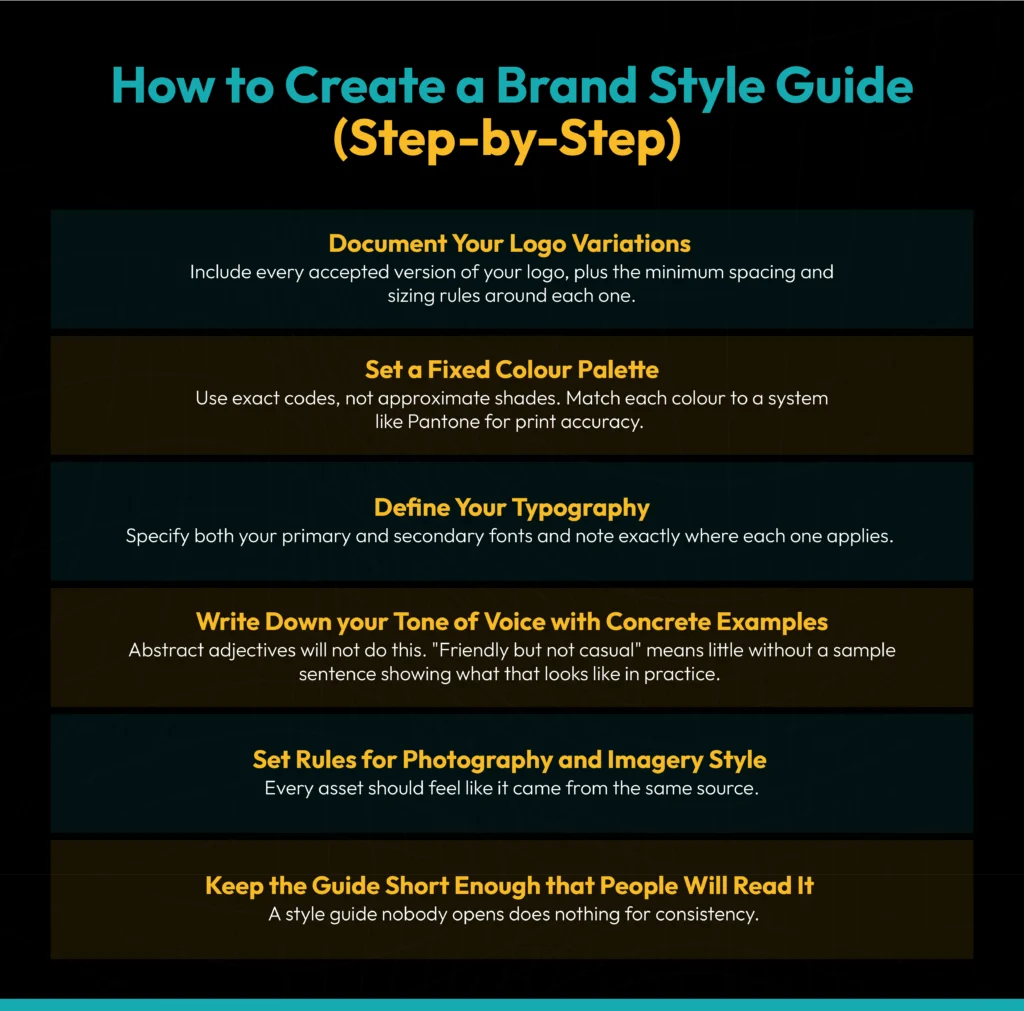
These tools solve the enforcement gap from the previous section. A style guide is a set of rules. A DAM or templating platform makes those rules the path of least resistance, so following them takes less effort than ignoring them.
How to Audit Your Brand for Consistency Right Now
Pull up your website, your most recent five social posts, your email signature, and your Google Business Profile side by side. Ask five questions.
- Does the logo match everyone?
- Do the colours match exactly, not approximately?
- Does the tone of voice sound like the same business?
- Is your business name and description identical everywhere, including directories and citations?
- Would a stranger recognise all four as coming from the same company without anyone telling them?
If the answer is no to more than one of these, you have a consistency gap worth fixing before you spend another pound on advertising to drive traffic toward it.
Need Help with Brand Consistency?
A style guide only works if someone enforces it. If your branding has drifted across your website, social channels, and directory listings, a proper audit will show you exactly where the gaps are and what they are costing you in recognition, trust, and AI visibility.
If your visual identity needs a full refresh, not just a written guide, our graphic design team can rebuild it from the ground up.
Get a free brand audit and see how consistent your brand looks from the outside.
FAQs
What is brand consistency?
Brand consistency is presenting the same logo, colours, tone of voice, and messaging across every place your business appears, including your website, social media, email, and advertising. The goal is that a customer recognises your business the same way regardless of where they encounter it.
How does consistent branding increase revenue?
Estimates vary. A 2016 Demand Metric and Lucidpress study put the figure at 23%, later research put it as high as 33%, and Marq’s current data suggests a more conservative 10 to 20%. The exact number depends on the study, but every version points in the same direction: consistent brands report meaningfully stronger revenue than inconsistent ones.
What should a brand style guide include?
A brand style guide should include logo variations and spacing rules, an exact colour palette with hex or Pantone codes, primary and secondary typography, tone of voice guidance with concrete example sentences, and rules for photography and imagery style.
How many brand impressions does it take to build recognition?
You will often see “5 to 7 impressions” quoted as a fixed rule. This figure has no traceable primary study behind it. It is a version of older marketing folklore rather than confirmed research. Repetition does reliably build recognition over time, so treat any exact number attached to it with caution.
What is the difference between brand identity and brand image?
Brand identity is what you control: your logo, colours, tone of voice, and messaging. The brand image is how customers perceive you based on their experience. Strong brand consistency narrows the gap between the two, so your intended identity and your customers’ perception line up.
How do I ensure brand consistency across social media?
Keep your logo, colour palette, and core vocabulary identical across every platform, and let only the format flex. A platform strategy helps here, since picking the right channels for your audience makes it easier to maintain one consistent voice instead of stretching thin across too many.
Can a small business benefit from brand consistency?
Yes. Small businesses often have fewer touchpoints to manage, which makes consistency easier to achieve, and the payoff more visible. A consistent small business brand competes on recognition and trust against larger competitors with bigger budgets but messier presentation.