


How search really works now, and where UK businesses should focus.
If you run a UK business, nearly every customer you’re trying to win starts on Google, which handles around 91% of the country’s searches. But here’s what’s changed in 2026: close to 6 in 10 of those searches now end without a click, because Google answers them on the page, with AI summaries sitting above the results. So the real question isn’t whether SEO matters. It’s why some businesses keep showing up where it counts, while others, often with better products and nicer sites, stay invisible.
Here’s how Google finds and ranks you in 2026, what’s genuinely changed with AI, and where a small team should focus to win the searches that still bring in paying customers.
❝ SEO (Search Engine Optimisation) is the practice of improving your website so it ranks higher in search results. It works through three pillars, technical optimisation, quality content, and authoritative backlinks, that help search engines find, understand, and trust your site so more customers discover you organically. ❞
TL;DR:
There’s no shortcut to SEO in 2026. The same crawlable, credible, genuinely useful pages that earn organic rankings are the ones Google’s AI summaries quote, so getting the fundamentals right is what pays off in both places.
What Is SEO?
SEO is how you earn visibility in the organic search results, the listings Google ranks on relevance and authority rather than ad spend. The three pillars work together. Technical optimisation makes your site easy to crawl and quick to load. Quality content answers what people are actually searching for. Backlinks from other sites tell Google your pages can be trusted. Strong content on broken technical foundations rarely ranks, and a fast site with thin content has nothing worth ranking.
How Is SEO Different from Paid Advertising?
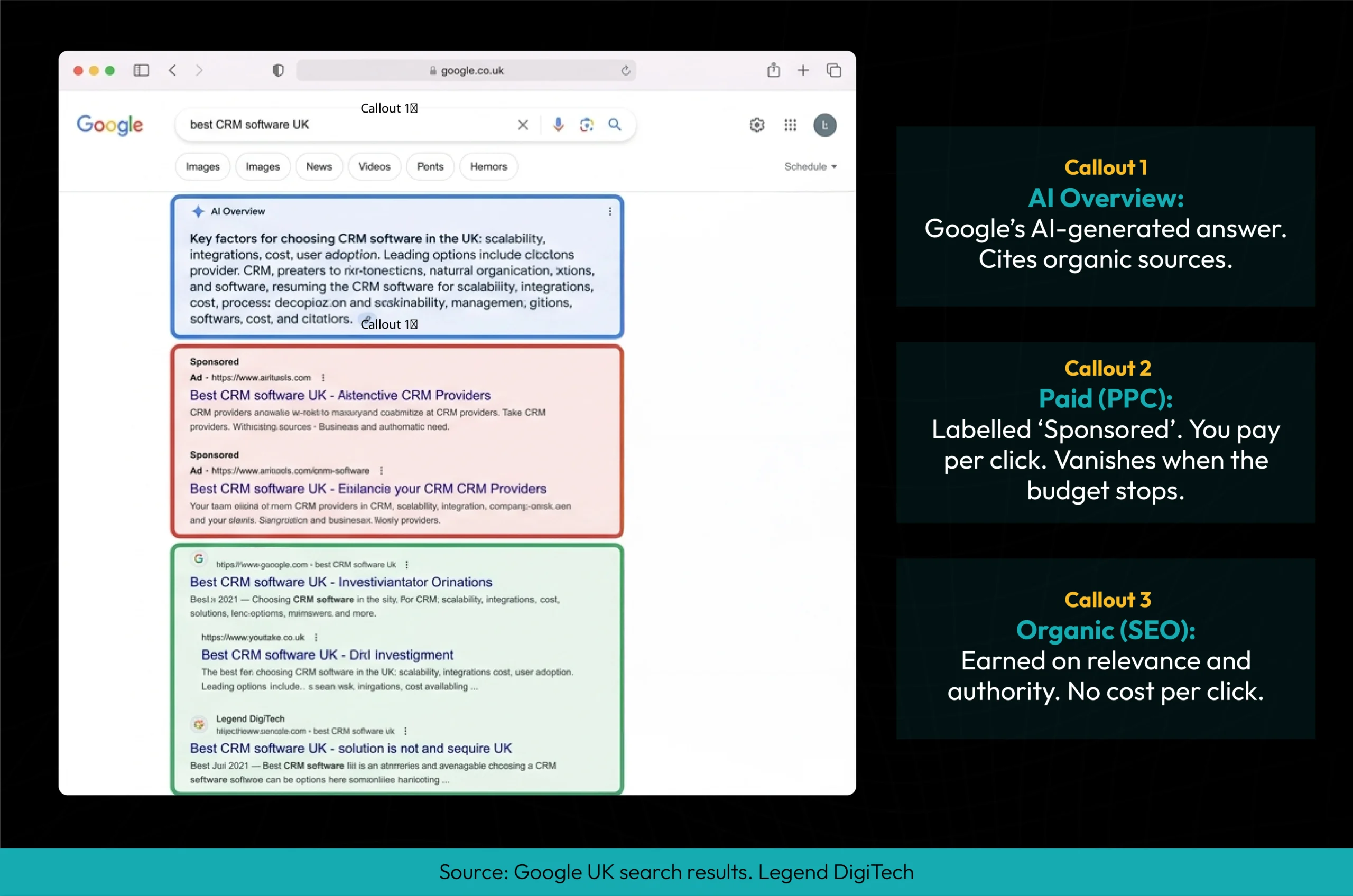
With paid ads (Google Ads or PPC), you pay for every click, and your visibility stops the moment your budget runs out. With SEO, you invest time, often a few months, to build rankings that keep delivering traffic with no ongoing cost per click. The difference is clear on any results page (SERP): paid ads sit at the top marked “Sponsored”, while organic results earn their spot on relevance and authority.
Why Does SEO Matter for Your Business in 2026?
Organic search is still where most buying journeys start, and it’s the one channel you don’t rent. But 2026 adds a twist worth understanding before you spend a penny. As AI Overviews answer more questions directly, raw traffic has become a weaker goal than it used to be.
What still sends real clicks, and real customers, are searches with commercial or local intent: people comparing providers, ready to buy, or looking for a business near them. The job now is to win those, and to become the source Google’s AI quotes for the rest.
How Do Search Engines Work?
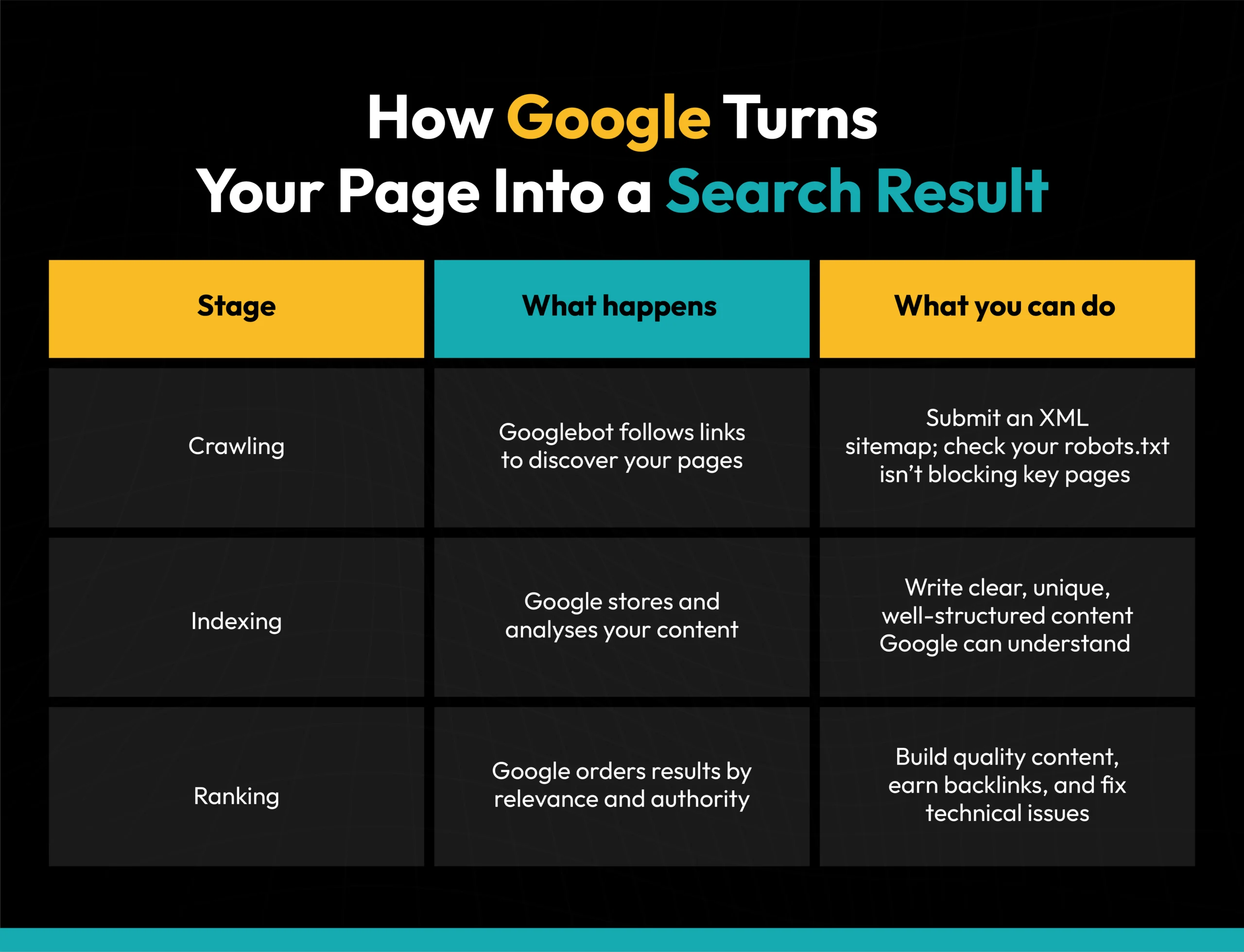
Search engines work in three stages: crawling (discovering pages), indexing (storing and understanding them), and ranking (deciding which pages show for which searches). Your SEO strategy shapes how well Google does all three on your site.
What Is Crawling and Why Does It Matter?
Googlebots are small spider-like crawlers that move from one link to the next, page by page. If a page on your site has no internal links pointing to it, Googlebot may never find it. Your XML sitemap and internal linking structure guide Google to your content.
What Does It Mean for a Page to Be Indexed?
Once Googlebot crawls a page, Google decides whether to add it to its index. Pages that are thin, duplicated, or blocked by robots.txt can be left out. If a page isn’t indexed, it can’t rank, no matter how good the content is. Google Search Console tells you exactly which of your pages are indexed.
How Does Google Decide Which Pages Rank Highest?
Google uses hundreds of ranking signals to order results, but it’s always answering one question: which page best satisfies what this person is looking for? For your site, relevance, page quality, and trust signals do most of the heavy lifting.
The Three Core Pillars of SEO
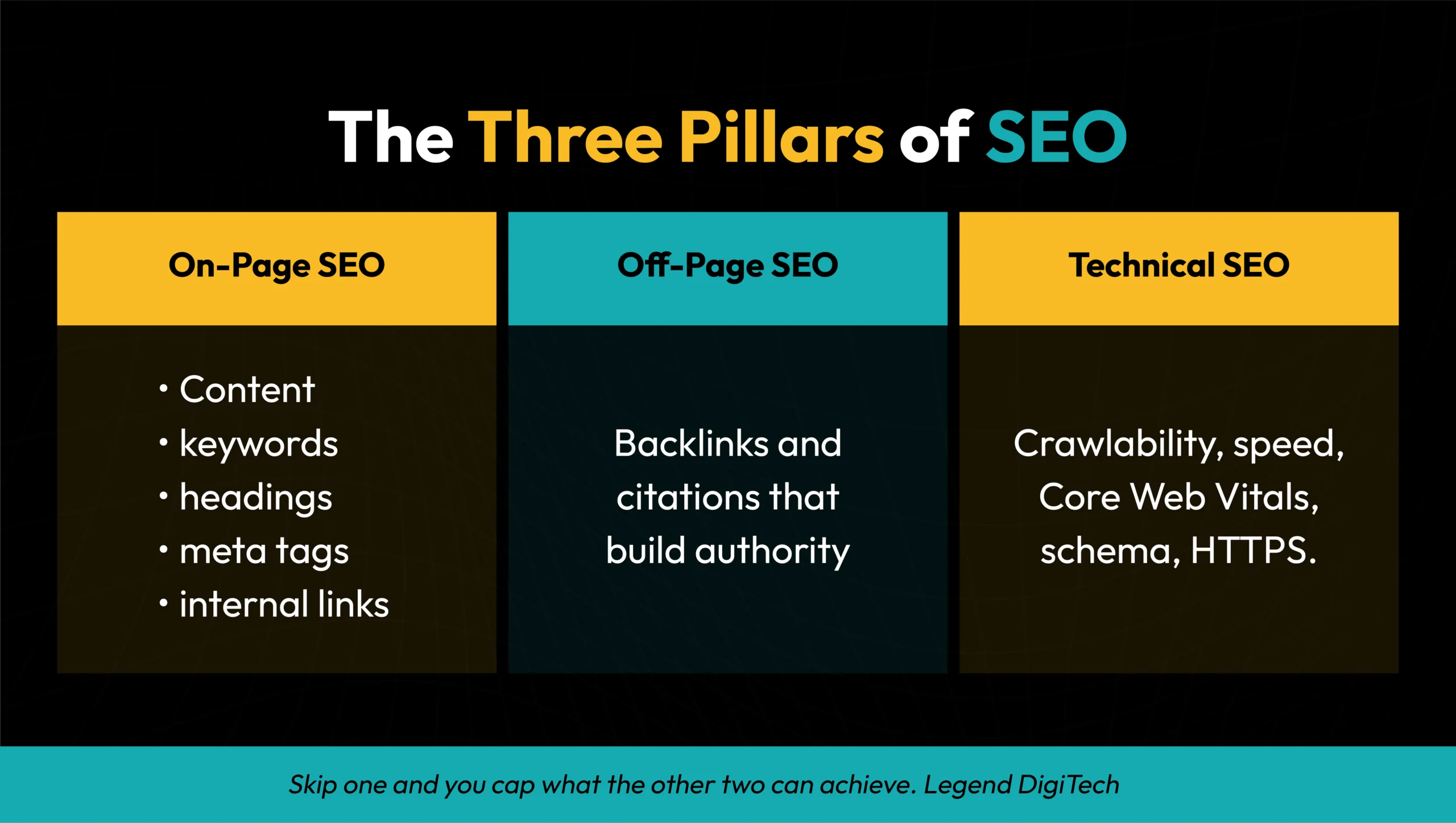
The three pillars of SEO are on-page (your content and how it’s structured), off-page (links from other sites that build your authority), and technical (the behind-the-scenes factors that decide whether Google can properly access and understand your site). Skip one and you cap what the other two can achieve.
What Is On-Page SEO?
On-page SEO covers everything on your actual pages: the keywords you target, the quality and depth of your content, your heading structure (H1, H2, H3), meta titles and descriptions, internal links, and image alt text. It’s the most direct lever you have. A well-optimised page tells Google clearly what topic it covers and why it deserves to rank.
What Is Off-Page SEO and Why Do Backlinks Matter?
Off-page SEO is mostly about backlinks, the links from other websites pointing to yours. Google treats them as votes of confidence, the same idea behind its original PageRank algorithm, which scored pages on the number and quality of links pointing to them. A link from a respected site like the BBC or a major industry publication carries far more weight than one from a low-quality directory. Earning genuine backlinks through digital PR, guest content, and citations is slower than on-page work, but it’s still one of the strongest signals Google uses.
What Is Technical SEO?
Technical SEO is the foundation that lets Google crawl, index, and understand your site without obstacles. It covers page speed, mobile usability, Core Web Vitals, HTTPS, structured data (schema markup), and fixing crawl errors. A site with great content but slow or broken architecture will rarely rank.
How Has AI Changed SEO in 2026?
This is the biggest shift, and it’s why a 2026 guide reads differently from one written five years ago. Google’s AI Overviews now sit above the organic results and answer many queries outright, so ranking first no longer guarantees the click. Ahrefs calls the pattern the Great Decoupling: impressions keep climbing while clicks fall away. Their data shows the top organic result can get a 58% lower click-through rate once an AI Overview appears.
For a small business, that can sound discouraging. It points somewhere useful, though. Lean into the searches AI can’t answer for free, the commercial, local, and decision-stage queries where people still click through to buy, and structure your content so AI systems can quote it. That second part is Answer Engine Optimisation.
What Are Google AI Overviews and How Do They Affect Traffic?
Google AI Overviews are AI-generated summaries at the top of search results that pull from several sources to answer a query directly. The pages they cite are usually the ones already ranking in the top 10 for that keyword. So traditional SEO and AI visibility aren’t separate games: the work that earns rankings is the same work that gets you quoted.
What Is Answer Engine Optimisation (AEO)?
AEO is structuring your content so AI systems, Google, ChatGPT, Perplexity, Claude, can pull out a clean answer and cite it. In practice that means leading each section with a direct answer, using schema markup, and covering a topic properly rather than skimming it. It’s the next layer of SEO, not a replacement.
What Is AISEO and How Does It Work?
AISEO, or Artificial Intelligence Search Optimisation, is the practice of getting your business cited inside AI-powered search, the Google AI Overviews, ChatGPT, Perplexity, and other answer engines that now answer questions before anyone reaches your site. Where traditional SEO works to rank you, AISEO works to get you named in the answer itself, and with AI Overviews past 2 billion monthly users by mid-2025, that visibility increasingly comes first.
It builds on SEO rather than replacing it. Google has been direct that optimising for AI search runs on the same systems as ordinary results, and the pages AI tools cite are usually the ones already ranking on strong content, structured data, and topical authority. Our guide to optimising for Google’s AI search breaks down what the company officially recommends, and which popular tactics don’t actually move the needle.
Key SEO Ranking Factors You Need to Know
In 2026, a handful of factors carry most of the weight. Google confirms these as primary signals, though it uses hundreds in total.
Which Ranking Factors Have the Most Impact in 2026?
The strongest and most consistent factors are:
- Content quality and relevance: does your page answer the query better than the pages it’s up against?
- Backlink authority: how many reputable sites link to you?
- Core Web Vitals: Google’s loading, interactivity, and stability metrics.
- E-E-A-T: real experience and expertise behind the content, which Google leans on hardest for health, money, and big-decision topics.
- Mobile usability: Google indexes the mobile version of your site first.
What Tools Can You Use to Track Your Rankings?
Three tools cover most of what a UK business needs. Google Search Console is free and shows which queries you rank for, your average position, and any indexing issues, which makes it the non-negotiable starting point. Ahrefs and Semrush go deeper on backlinks and keyword research, but both are paid.
How Long Does SEO Take to Show Results?
Most businesses see measurable results within 3 to 6 months, with bigger gains building between 6 and 12. SEO compounds: Ahrefs found the average page ranking at number one is about five years old, and roughly 73% of top-10 pages are more than three years old. That’s not a reason to wait, it’s a reason to start, because authority takes time to bank.
Legend DigiTech saw this with a Harley Street medical clinic recovering from a security incident. Within 6 months, organic patient traffic climbed from 119 to 278 visits (up 134%), average ranking position improved from 54.1 to 23.3, and the clinic’s pages started appearing in Google’s AI Overviews for patient questions. Results depend on the starting point and the work involved, so treat it as one illustration, not a promise.
How Fast Can You Realistically Expect Results?
It depends on four things: how competitive your keywords are, how established your domain is, how consistently you publish, and how solid your technical foundation is. A local business chasing less competitive terms can see movement in 2 to 3 months. A new site going after national, high-volume keywords should plan for 6 to 12. Expect fluctuation early, the first ranking gains around months 3 to 6, and clearer traffic growth from month 6 on.
SEO vs PPC: Which Is Right for Your Business?
SEO and PPC solve different problems. PPC buys instant visibility, which is useful for launches, seasonal pushes, or testing a new market. SEO builds an asset that keeps working without paying per click.
The trade-off is real. We cut a UK private-hire firm’s cost per booking by around 70% with paid search in two weeks, but the day they paused the budget, those bookings stopped. SEO is the opposite: slower to arrive, far harder to switch off, which is why most businesses run both.
| Factor | SEO | PPC |
|---|---|---|
| Cost Model | Invest time and resources upfront; no cost per click | Pay per click; costs stop when the budget stops |
| Speed to Results | 3 to 12 months | Immediate |
| Longevity | Rankings can persist for years | Visibility ends when spend ends |
| Trust Factor | Organic results are trusted more by users | Ads are labelled and skipped by many users |
| Best Use Case | Long-term traffic growth and brand authority | Product launches, seasonal campaigns, and quick testing |
How to Get Started with SEO (or Hire an Expert)
The first step for any UK business is an SEO audit: a structured look at your technical health, content, and backlink profile, so you fix the right things first instead of guessing. A free SEO audit is a low-risk way to see where you stand.
What Should You Do First if You’re New to SEO?
Work through four steps:
- Set up Google Search Console: it’s free and immediately shows which queries your site ranks for and which pages have issues.
- Fix your technical foundations: check page speed (Google’s PageSpeed Insights tool is also free), make sure your site is mobile-friendly, and confirm key pages are indexed.
- Identify your 5 to 10 target keywords: focus on the terms your ideal customers actually search.
- Start with one well-optimised page per keyword: quality over quantity, especially if your site is new.
When Does It Make Sense to Hire an SEO Agency?
SEO takes sustained discipline. Keyword research, technical audits, content strategy, link building, and analytics each need dedicated attention. If your business depends on organic search for revenue, working with an experienced technical SEO and local SEO team will speed up results compared with doing it alone.
FAQs
What Does SEO Stand For?
SEO costs depend on scope and the agency you work with. A monthly retainer with a UK agency typically runs from £500 to £3,000 for small and medium-sized businesses, with larger or more competitive campaigns costing more. Budgets below £500 a month carry a real risk of low-quality, automated work that can harm your rankings.
How Much Does SEO Cost in 2026?
No. Google states that optimising for generative AI search is still SEO, because AI Overviews and AI Mode use the same index and ranking signals as classic Search. AEO and GEO describe the goal of appearing in AI answers, not a separate method you need to buy. The work that earns rankings is the work that earns AI visibility.
How Long Before I See Results From SEO?
You usually see measurable results within 3 to 6 months of consistent work. A new site, or one targeting competitive keywords, can take 6 to 12 months. The timeline depends on your domain’s age, your competition, and how steadily you publish quality content.
What Is the Difference Between On-Page and Off-Page SEO?
On-page SEO is everything you control on your own pages: content, keywords, headings, meta tags, internal links, and image alt text. Off-page SEO is the authority you build elsewhere, mainly through backlinks from other websites. On-page tells Google what your page is about; off-page tells Google other sites trust it.
Do I Need SEO if I Already Run Google Ads?
Yes, the two work better together than either does alone. Google Ads gives you immediate visibility and useful keyword data, but it stops the moment your budget runs out. SEO builds organic rankings that keep working without ongoing spend, and many users skip paid ads to click organic results, particularly when researching a purchase or comparing providers.
What Is E-E-A-T and Why Does It Matter?
E-E-A-T stands for Experience, Expertise, Authoritativeness, and Trustworthiness, Google’s framework for judging content quality. It matters most for topics that affect people’s health, finances, or major life decisions, where Google sets a higher bar for who it ranks. Showing real expertise, author credentials, and credible sources helps your content meet that bar.
Your Competitors Are on Page One. Are You?
Ranking on Google doesn’t happen by accident. It takes the right technical foundations, content that earns its place, and a strategy built around how search actually works in 2026.
Legend DigiTech’s free SEO audit shows you where your site stands, what’s holding it back, and exactly what to do next. Or if you’d rather talk it through with our team, we’re around.


