


Ask five business owners what a website should cost and you’ll get five different answers, all confidently wrong. One paid £300 on Wix and is thrilled. Another spent £18,000 with an agency and still isn’t sure what they got for it. Neither number tells you what website development cost in the UK should actually look like for your business.
The real answer depends on three things: what the site needs to do, who builds it, and how much you value your own time. Skip any one of those and you’ll either overpay for features you don’t need or underpay for a site that quietly costs you customers.
This guide breaks down what websites actually cost in the UK in 2026, by type of site and by who builds it, so you can set a realistic budget before you ask anyone for a quote.
Quick Answer: How Much Does a Website Cost in the UK in 2026?
❝ Website development costs in the UK range from £500–£2,000 for DIY builders (Wix, Squarespace), £2,000–£10,000 for freelancer-built sites, and £7,500–£30,000+ for agency-developed websites. For most UK startups and SMEs wanting a professional, SEO-ready site that generates leads, a realistic budget is £5,000–£15,000. Ongoing costs (hosting, maintenance, updates) add £500–£2,000/year ❞
Why Website Costs Vary So Widely
Two businesses can ask for “a website” and need completely different things. That’s the main reason quotes swing so wildly, and why comparing prices without comparing scope gets you nowhere.
Purpose is the first variable. A five-page brochure site that just needs to look credible costs nothing like an ecommerce store processing payments, managing stock and handling returns.
Quality is the second. A template with your logo dropped in takes a few hours. A site designed around how your actual customers browse and buy, built to load fast and pass Google’s Core Web Vitals, takes a lot longer to get right.
Who builds it is the third. A DIY platform hands you the tools and lets you do the work yourself. A freelancer sells you their time and skill directly. An agency sells you a team. Design, development, SEO and strategy working together.
None of these is automatically right. It depends on what the site has to do for your business, which the next section breaks down.
Website Cost by Type
Brochure / Informational Websites
A handful of pages telling people who you are, what you do, and how to get in touch. No bookings, no payments, no logins. DIY: £500–£1,500. Freelancer, more tailored with proper copy and basic SEO: £1,500–£4,000. Agency, designed and built around your brand and search visibility: £4,000–£8,000.
Lead Generation Websites
These sites have one job: turn visitors into enquiries. Landing pages built around a single action, forms that get filled in, content structured around what a buyer needs to know before they call. Freelancer: £2,000–£6,000. Agency: £7,500–£15,000.
Ecommerce Websites
Selling products online adds product catalogues, payment processing, stock management, shipping rules, and security obligations around customer payment data. A small Shopify or WooCommerce store from a freelancer: £3,000–£8,000. A fuller agency build with custom design and checkout optimisation: £10,000–£25,000+.
Larger catalogues, bespoke functionality or multi-currency requirements push costs higher. If ecommerce is the route, it’s worth working with a team that also thinks about how the store gets found and converts traffic, not just how it’s built. Our ecommerce marketing services cover that side once the site is live
Custom Web Applications
This covers anything beyond a standard website: customer portals, booking systems, membership platforms, or software-like functionality. Bespoke backends are usually built on Laravel or Django; frontends commonly use React or Next.js; simpler no-code builds often run on Bubble.
There’s no off-the-shelf version of this, which is why it’s the most expensive category. Costs typically start around £15,000 and can run well past £50,000. If your business idea is the website, treat this as a software project, not a marketing one.
Website Cost by Who Builds It
DIY Website Builders (Wix, Squarespace)
Platforms like Wix and Squarespace let you build and publish a site yourself, with no coding and no developer fee. You’re paying for the subscription, not the labour. Costs typically run £10–£40 a month, or £500–£2,000 a year once you factor in a premium template, a custom domain and occasional paid support.
This route works well for very small businesses, sole traders and anyone testing an idea before committing budget. The trade-off is time. You’re doing the design, copy and SEO yourself.
Freelance Web Developers
A freelancer sells you their own time directly, which is why they usually sit in the middle of the market. According to Per Earns UK Freelance Rate Benchmarks 2026, the average UK web development day rate is £431/day nationally, rising to £575/day in London (a 33% premium). A full project typically lands between £2,000–£10,000 depending on scope.
You get more flexibility and often a lower price than an agency. What you don’t get is a team — if your developer is also doing design, copywriting and SEO, something usually gets less attention than it should.
Digital Marketing Agencies
An agency sells you a team rather than an individual: designers, developers, SEO specialists and a project manager working from the same brief. That coordination is why agency pricing runs higher, typically £7,500–£30,000+.
What you’re paying for beyond the build is the strategy behind it: a site designed to be found in search, structured around how your customers buy, built to a standard that holds up as the business grows. For startups and SMEs that need the website to generate business, not just exist, this is usually where the budget should go.
Hidden and Ongoing Website Costs to Budget For
The build cost is only the first invoice. A website is never really “finished,” and the businesses that get caught out are usually the ones who budgeted for the launch and forgot everything that comes after.
- Hosting keeps your site live and accessible. Basic hosting runs £5–£25 a month, while higher-traffic or ecommerce sites need more robust hosting at £25–£100+ a month.
- Domain registration is small but easy to forget. A UK domain typically costs £10–£20 a year, and it needs renewing on time or you risk losing it altogether.
- SSL certificates are now standard, not optional. Most hosting packages include one for free, but some agencies charge separately, around £50–£150 a year if it isn’t bundled in.
- Maintenance and updates cover the unglamorous work of keeping a CMS, its plugins and its security patches current. Skip this and a site becomes slow, vulnerable, or both. Expect £500–£2,000 a year for basic upkeep, more if the site is complex.
- Content updates are easy to underestimate. A site that never changes after launch slowly loses relevance and search visibility, which is part of why SEO and content work together rather than as separate jobs.
- Ecommerce-specific costs add another layer: payment gateway fees, for example Stripe’s standard UK rate is 1.5% + £0.20 per transaction for UK-issued cards, though this varies by plan, volume and whether the customer’s card was issued in the UK, EU or further afield, plus any subscription costs for platforms like Shopify on top of hosting.
Add it up and most UK startups and SMEs should budget £500–£2,000 a year in ongoing costs, more for ecommerce. Skip this and the site that looked great at launch quietly stops working a year later, because nobody planned past day one.
What Does a Good Website Actually Include?
Price tells you what you’re paying. It doesn’t tell you what you’re getting. Two sites at the same price point can deliver very different results, and the difference usually comes down to whether these basics were covered.
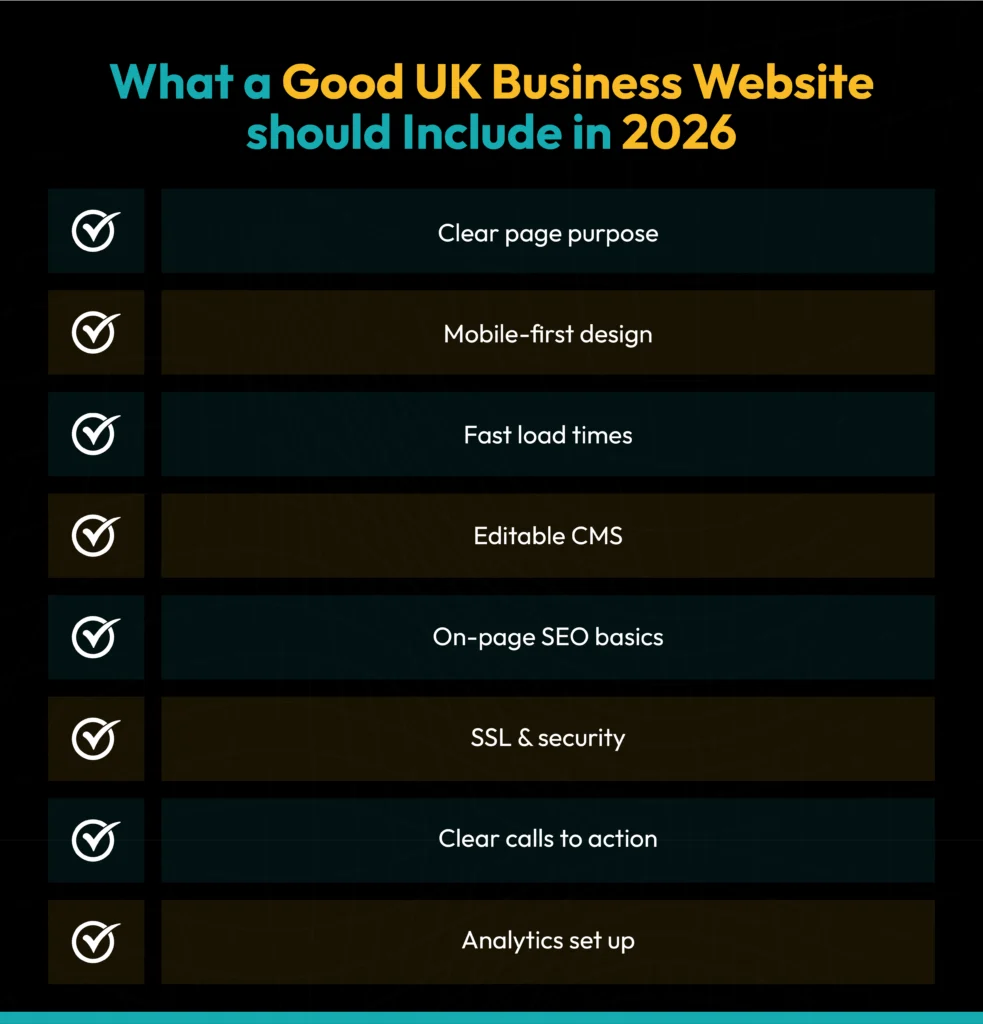
- A clear purpose for every page. Each page should have one job, whether that’s explaining a service, answering a question, or getting someone to enquire.
- Mobile-first, responsive design. Mobile-first, responsive design. Per Ofcom’s Online Nation 2025 report, UK adults now spend 77% of their online time on smartphones. If it doesn’t work properly on a small screen, it doesn’t really work.
- Fast load times and good Core Web Vitals. Google factors page speed and stability into how it ranks sites. A slow site loses visitors before they’ve seen what you offer, and loses search visibility too.
- A proper content management system. Whether that’s WordPress, Shopify, or something else, you need to be able to update content yourself without going back to a developer every time.
- On-page SEO basics, including title tags and meta descriptions, confirmed ranking factors per Google Search Central, Core Web Vitals (LCP, CLS and INP, Google’s page experience signals), and structured data markup for the FAQ and Article schema this piece needs. Our SEO services team builds these in from the start rather than retrofitting them after launch.
- SSL and basic security. A secure connection (the padlock in the browser bar) is now a baseline expectation, not a feature to brag about.
- Clear calls to action. Every page should make it obvious what you want the visitor to do next.
- Analytics set up from day one. Without tracking, you can’t tell what’s working, which makes every future decision a guess instead of a choice.
Anything beyond this list is a “nice to have” worth paying extra for, if it earns its place. Anything missing from this list is worth questioning, no matter how good the design looks.
Startup Website Costs: What's Realistic on a Tight Budget?
Most startups don’t need an elaborate website, just one that looks credible, explains what they do, and doesn’t fall over the first time someone clicks through. Spending big at this stage often means paying for features the business hasn’t earned the need for yet.
A sensible starting budget is £1,500–£5,000: a well-built brochure or simple lead-generation site, from a freelancer or a smaller agency package. If cash is tight, a DIY build for £500–£1,500 is a legitimate starting point, not a compromise. The priority is having something live and credible, not perfect.
What’s worth avoiding is committing £10,000+ to a custom build before you’ve validated what your customers respond to. Plenty of early-stage businesses pivot their messaging or audience within the first year, and a smaller, flexible site lets you make that change without writing off a large investment.
Before spending anything, ask: does the site need to do more than explain the business and capture enquiries? Will the offer or audience likely change in the next year? For most startups, the honest answer is to spend modestly now and reinvest once there’s traction.
SME Website Costs: When to Invest More
Once a business has an established customer base and a track record, the calculation changes. A website stops being just a credibility check. It becomes a growth channel in its own right. Underinvesting at this stage costs more than overinvesting did when you were a startup.
A realistic budget for an established SME is £5,000–£15,000. That covers a properly built lead-generation or small ecommerce site, with solid SEO foundations, conversion-focused design, and content built around the questions your buyers are actually asking. At this range, the site starts paying for itself through enquiries, rather than sitting there as a digital business card.
A few signals tell you it’s time to spend more rather than patch what you have:
- Your current site is slow, has broken forms, or hasn’t been updated in years. That’s lost enquiries, not savings.
- Competitors with weaker offers are outranking you in search. The gap is usually technical, not something a few blog posts will fix.
- Your sales team keeps fielding the same questions on calls. Your site isn’t doing enough of the selling before the call happens.
It also helps to treat an SME site as something to build on, not a one-off project. Case studies, service pages for each offer, and content built for AI search visibility all compound over time. A £15,000 site that keeps earning its place in search results for years beats three £5,000 sites rebuilt from scratch because nobody planned for what came after launch.
The real question isn’t what you can afford to spend. It’s what staying as you are is costing you. For most SMEs past the early stage, that second number is the bigger one.
5 Costly Mistakes UK Businesses Make When Budgeting for a Website
Most website budgets don’t go wrong because the business spent too little or too much. They go wrong because the money went to the wrong place, or the decision was made for the wrong reasons.
- Choosing the cheapest quote without comparing scope. Two quotes can both say “5-page website” and mean completely different things. Comparewhat’s included, not just the number at the bottom.
- Treating the website as a one-off cost. Budgeting for the build and nothing else is how sites end up abandoned, insecure or invisible in search a year later.
- Overbuilding beforevalidatingthe business. Spending £15,000 on a custom site before you know what your customers respond to means rebuilding it once your offer or audience shifts. Early on, flexibility is worth more than polish.
- Underbuilding once the business has outgrown a basic site. Sticking with a DIY site or an old freelancer build once you havea track record means losing enquiries to competitors with stronger search visibility and conversion design.
- Ignoring SEO and AI search visibility at the build stage. A site built without proper structure, content and technical SEO, schema markup, Core Web Vitals,canonical tags, is hard for Google, Google AI Overviews, ChatGPT Search and Perplexity to find or recommend. Adding SEO after launch costs more than building it in from the star
Overbuilding before you’ve validated the business, and underbuilding once you’ve outgrown your first site, are the two mistakes that cost UK businesses the most. Both come from treating the website as a fixed decision instead of one that should evolve with the business.
How to Choose the Right Web Development Partner in the UK
Look at relevant experience, not just a portfolio. Ask for examples in your sector or your type of project, not just their best-looking work.
Ask how they handle SEO, not whether they do it. A vague answer to “what does that actually involve” is usually a sign it’s an afterthought.
Check who owns the site once it’s built. Some agencies build on proprietary platforms you can’t move away from. Confirm you’ll own the domain, hosting account and CMS outright.
Get clarity on what happens after launch. Ask what’s included in the build versus what becomes a separate ongoing cost.
Compare communication style, not just cost. A partner who’s slow or unclear before you’ve signed anything rarely improves once they have your money.
Be wary of guaranteed rankings or unrealistic timelines. No legitimate partner can guarantee a specific Google ranking, and a proper build takes weeks, not days.
The right partner isn’t the cheapest or the most expensive. It’s the one whose experience and process match what you’re actually asking them to build.
If your time and budget are split across decisions with no clear reason behind them, results get inconsistent and hard to measure. See how our web development services can help you make smarter decisions with a website built around your business goals.
Get Expert Help Choosing the Right Setup
The hardest part of budgeting for a website usually isn’t the number, it’s knowing which option actually fits your business. Spend too little and you end up rebuilding within a year. Spend too much too soon and you’re carrying a cost the business hasn’t grown into yet.
Get a free website quote. We’ll look at what your site needs to do, who’s the right fit to build it, and give you a realistic number, not just a price.
Frequently Asked Questions
How Much Does a Basic Website Cost in the UK?
A basic brochure-style website typically costs £500–£2,000 through a DIY builder like Wix or Squarespace, or £1,500–£4,000 if you bring in a freelancer for a more tailored result. For most small businesses that just need a credible online presence, this range covers it.
How Much Does a WordPress Website Cost in the UK?
A WordPress site built by a freelancer usually costs £2,000–£8,000, depending on design complexity and the number of pages. Agency-built WordPress sites with custom design and SEO setup typically run £7,500–£20,000+. WordPress itself is free; the cost is the design, development and hosting around it.
Is £5,000 a Reasonable Budget for a Business Website?
Yes, for most SMEs. £5,000 sits at the lower end of a properly built lead-generation site from an agency, or comfortably covers a strong freelancer build. It’s enough for solid SEO foundations and conversion-focused design, without stretching into custom application territory.
What Ongoing Costs Should I Expect After Launch?
Budget £500–£2,000 a year for hosting, domain renewal, security and basic maintenance on a standard site. Ecommerce sites typically sit at the higher end of that range, or above it, once payment gateway fees and platform subscriptions are factored in.
How Long Does It Take to Build a Website in the UK?
A simple brochure site usually takes 2–4 weeks. A lead-generation or small ecommerce site typically takes 6–10 weeks. Larger ecommerce builds or custom web applications can take 3–6 months or more, depending on complexity and how quickly feedback is turned around.
What Is the Difference Between Web Design and Web Development?
Web design covers how a site looks and how it’s structured for the user: layout, visuals, user experience. Web development covers how it’s built and how it functions: the code, the CMS setup, and any technical features. Most agencies and many freelancers offer both, but it’s worth knowing which you’re actually paying for.
Do I Need to Pay VAT on Website Costs in the UK?
Yes, in most cases. If your web developer or agency is VAT-registered, VAT is added to their fees at the standard rate. If you’re VAT-registered yourself, you can usually reclaim it. Always confirm whether a quote is VAT-inclusive before comparing prices between providers.