


Every few years a new technology promises to change how customers find you. Augmented and virtual reality have carried that promise for over a decade, and for most of it the results never matched the headlines. That is finally changing, though not in the way the early hype suggested.
Most AR and VR marketing articles stop at definitions and a few flashy campaigns. This guide goes deeper. AR overlays digital content onto the real world, letting customers try products through their phone camera. VR replaces the real world with an immersive digital environment for experiences like virtual stores, demos, and brand stories. Both help customers experience products before buying and that is where their real value lies.
TL;DR:
AR and VR let people experience a product before buying, and that confidence shortens the path to purchase. Used well, the tools lift sales and cut returns. Used as a gimmick, they cost money and change nothing. The test is whether the experience solves a real problem. It must be tied to one metric and properly measured.
What is AR Marketing?
AR marketing adds digital content on top of the real world, reaching customers through a device they already own.
Augmented reality keeps you in your real surroundings and simply drops digital objects into them. Point your phone at a room to preview a sofa or open a filter to see a lipstick shade on your own face. Because the real world stays visible the whole time, AR feels low-effort, and that easy access is why it reaches so many people.
The 10 strategies below form the foundation of most successful ecommerce campaigns.
What is VR Marketing?
VR marketing replaces the real world with a digital one, explored through a headset such as a Meta Quest.
Virtual reality removes your surroundings completely and drops you into a fully built digital space. Brands use it to create virtual stores people can walk through, or to stage demonstrations in places that would be impossible to film. The trade-off is immersion for effort: VR goes deeper than any other format, but it asks more of the user in hardware.
AR vs VR vs MR: What's the Difference?
The three technologies differ in how much they change your view of reality. AR adds digital objects to your surroundings, while MR takes this further by allowing those objects to interact with the space around you. VR goes furthest by replacing the real world with a fully digital environment. The table below shows what each technology means for marketers in practice.
| Technology | What it does | Typical device | Best marketing use |
|---|---|---|---|
| AR (Augmented Reality) | Adds digital objects onto your real world. | Smartphone | Try-on experiences, product trials, and customer engagement. |
| MR (Mixed Reality) | Digital objects interact with your real environment. | Headset or smart glasses | Hands-on visualization, product demonstrations, and collaboration. |
| VR (Virtual Reality) | Replaces the real world with a fully immersive virtual environment. | VR Headset | Storytelling, virtual showrooms, employee training, and immersive experiences. |
Apple’s Vision Pro pushed mixed reality into the mainstream conversation, and together the three sit under one umbrella: extended reality, or XR. The marketing split stays easy to remember. Use AR for reach, MR for visualisation, and VR for depth.
For one of our UK private-hire clients, a campaign restructure plus aggressive negative-keyword pruning cut cost per acquisition by around 70%, down to £3.09 at a 10.27% click-through rate. For benchmarking, Littledata’s Shopping data puts the average ecommerce conversion rate from Shopping at 1.4%. Top-quartile stores reach 2.6% to 3.5%. Treat it as a reference, since it varies by category and price point.
Why AR and VR are Changing Brand Marketing in 2026
AR and VR matter now because they finally reach everyday shoppers, not just early adopters. The hardware is getting lighter and cheaper, and the shape of the 2026 market tells brands where to focus.
Market-size estimates vary widely depending on what each analyst counts, so treat any single headline figure with care. Statista puts consumer AR and VR revenue near $50.9 billion in 2026 and expects roughly 10.5% annual growth through to 2030. Other forecasts run far higher or lower, which is exactly why the range matters more than any one number.
The hardware data tells a sharper story. IDC reports that XR device shipments grew 44.4% across 2025 and forecasts a further 33.5% rise in 2026. Almost all of that growth comes from lightweight smart glasses, while traditional VR headset shipments fell over the same period.
Demand is still early-stage, and that is the opportunity. Adoption sits low enough that brands moving now reach customers before the category gets crowded. With AR running on phones people already carry, the barrier to entry has never been lower.
AR Marketing Use Cases and Real Brand Examples
Brands mostly use AR to remove uncertainty before a purchase. The strongest examples all solve one shared problem: they help people picture a product in their own life.
Virtual Product Try-on (Beauty, Fashion, Furniture)
Virtual try-on is the most proven use of AR today. Sephora’s Virtual Artist, built on ModiFace, let customers try makeup shades through their phone camera. Deloitte reports more than 8.5 million visits to the tool, with around 200 million shades tried between 2016 and 2018. L’Oréal’s later AR work, the same Deloitte analysis notes, doubled the time shoppers spent on its sites and tripled conversion.
Furniture retailers follow the same visual logic. IKEA’s room-preview AR started as the IKEA Place app and was later rebuilt into IKEA Kreativ. Shoppers drop true-to-scale models into their own homes before buying, which answers the “will this fit my space” question directly.
That is why try-on lifts conversion and lowers returns: it closes the gap between imagining a product and seeing it. If you sell anything customers hesitate over on fit or look, this is where AR earns its place. It pairs naturally with your ecommerce marketing.
Interactive Packaging and Print
AR can turn static packaging or print into a doorway. A customer scans a code or points their camera, and the physical item unlocks something extra: a demo, a recipe, a how-to, or an offer. The product on the shelf stays the same, but the experience around it expands. Used well, it gives a buyer a reason to engage after the sale, not only before it. This works as a natural extension of your content marketing.
AR Social Filters and User-Generated Content
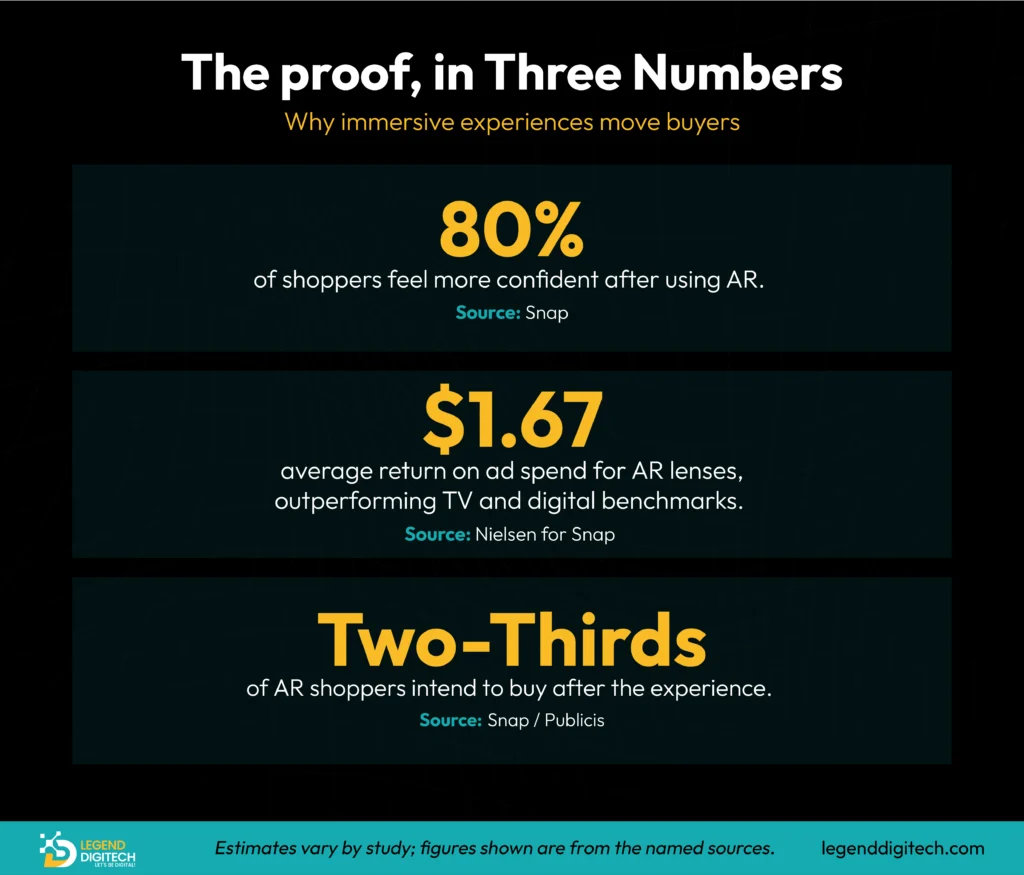
Branded camera lenses let people join a campaign themselves, then share the result and spread reach at very little extra cost. The supporting data from Snap is striking: two-thirds of AR shoppers say they intend to buy after using AR. That puts a customer-made message in front of an audience that already trusts it. This is where AR meets your social media marketing, and it works because the customer carries the message, not the brand.
Location-Based AR Experiences
Location-based AR ties an experience to a real place. It can guide someone through a store, light up a landmark, or turn a high street into a discovery trail. For local brands, that links a digital campaign to a real visit. Think of it as experiential marketing with a digital layer on top.
VR Marketing Use Cases and Real Brand Examples
Brands reach for VR when depth matters more than reach: a moment immersive enough to stick, or a demo that real life cannot easily provide.
Immersive Brand Storytelling
Storytelling is the most common use of VR. It carries a viewer somewhere tied to the product, and the best examples make that journey feel earned. Outdoor brand The North Face has dropped customers into remote landscapes most of them will never visit, so the gear feels tested rather than advertised.
Virtual Showrooms and Flagship Stores
Virtual showrooms let customers explore a full range online, walking through a branded space with no physical store attached. That suits car makers, property, and large product lines especially well. It brings the showroom to people who cannot easily travel to one.
Virtual Product Demonstrations
Some products are too large or too complex to show easily. VR can demonstrate them in a clear, guided way, and the same environments often double as digital twins. A digital twin is a virtual replica of a product that teams can test and refine before anything physical gets built.
Remote Events and Product Launches
VR can also host a launch or event for a global audience, with everyone sharing one digital space at the same time. This is usually where metaverse marketing sits, meaning a brand presence inside a persistent virtual world. The early hype has cooled, but practical branded events still earn their keep.
Gamification: The Third Pillar of Immersive Marketing
Gamification is the third pillar of immersive marketing. It turns a passive interaction into an active one by giving people a reason to participate, with a clear reward waiting at the end.
Points, challenges, and discovery mechanics encourage engagement and create reasons for people to return. AR and VR can deliver this loop especially well because they make participation feel more interactive. Location-based gaming is the clearest proof: Pokémon Go turned movement and exploration into a reward-driven experience, and brands have borrowed similar mechanics ever since. In the UK, Tesco introduced AR features in its app that encouraged shoppers to scan products and earn rewards, increasing interaction with products in store.
The lesson for brands is simple: gamify the path to a real goal, not the experience itself. Use challenges, rewards, or discovery mechanics when they help customers learn, choose, or engage with a product. A leaderboard with no purpose, a badge with no value, or a game that does not support a business goal only adds friction and wastes attention.
Before adding gamification, ask: does this help customers complete a meaningful action, or is it just decoration?
The Business Case: ROI and Engagement Data For AR/VR Marketing
Yes, AR and VR can drive sales when used well. They work best aimed at a real decision, not a gimmick. People buy with more confidence when they can see fit. They also return those considered purchases far less often.
Across several independent sources, the evidence points the same way. Snap reports that around 80% of AR shoppers feel more confident in a purchase after using AR, and that hundreds of millions of people have now used AR lenses billions of times. A separate Nielsen study commissioned by Snap looked at payback specifically, and across fifteen brands it found that AR lenses returned $1.67 for every advertising dollar, beating TV, digital, and total media spend. Add the Sephora and L’Oréal gains from earlier, and the pattern is consistent.
The brands that win aim AR at one real moment of doubt, then measure exactly what happens next.
How to Get Started with AR/VR Marketing (Budget Tiers)
Start small and tie the pilot to one clear outcome, then scale only once the numbers clearly support it. You do not need a headset programme or a big budget to begin.
WebAR is the simplest entry point, since it runs in a phone browser with no app to download, suits try-on, visualisation, and packaging activations, and reaches the widest audience for the least friction. A middle tier covers app-based AR and social lenses, which add polish and sharing for campaigns built around social platforms. Full VR sits at the deepest and priciest end, best reserved for showrooms, training, and complex demonstrations.
At Legend DigiTech, a UK digital marketing agency, we keep our AR and VR work deliberately practical. We start each idea as a small, focused pilot, usually running over four to six weeks, so a brand can test the real impact before committing to a full build. Most of our experiences run on mobile or the web, and we add headsets only when deeper immersion clearly earns the extra cost.
The Future Of AR/VR Marketing: What's Next for Brands?
The direction here is already clear, because immersive marketing is drifting steadily towards everyday smart glasses, which will make AR a normal part of how people shop. In our own work we are also seeing the cost of building these experiences fall, as generative tools take on production work that once needed a full studio, which puts a credible pilot within reach of a much smaller team.
One trap is worth watching as you plan, because rented platforms keep closing or changing hands. Meta shut its Spark AR studio to third-party creators in 2025, and 8th Wall, the company that coined WebAR, began winding down from 2026. Where you can, own your core experience on your own site rather than renting it from a platform that might disappear.
None of this needs a huge bet today, and the smarter move is to start small while the costs are still falling. The starting point is the customer problem you need to solve, long before the headset or the filter, and Legend DigiTech can help you find that first experience.
Ready to explore what’s possible? Partner with Legend DigiTech to discover how AR and VR Marketing can transform your customer experience. Get in touch today for a consultation, and let’s build an immersive solution that delivers measurable results.
FAQs
What is the difference between AR and VR in marketing?
AR adds digital content on top of your real world. You use a device like a phone to see it. VR replaces reality with a fully digital headset world. In short, AR gives reach while VR gives depth.
Which brands are using AR marketing successfully?
Beauty and retail brands currently lead the way here. Sephora and L’Oréal saw real gains, according to Deloitte. IKEA lets shoppers place furniture inside their own homes. Each one solved a real “how will this look” question.
How much does an AR marketing campaign cost?
There is no single fixed price for AR campaigns. Cost depends entirely on the type of experience built. WebAR in a browser is the most affordable option. App-based lenses sit in the middle of the range. Full VR remains the most expensive route by far. Start with a short pilot before any larger build.
Do customers need special equipment to experience AR marketing?
Usually, they need no special equipment at all. Most AR runs on a standard everyday smartphone. That works through a browser or a simple app. This is why AR reaches more people than VR. Headsets are only needed for full VR experiences.
Is AR or VR better for small business marketing?
AR is usually the better starting point for small businesses. It is cheaper and uses devices people already own. It also ties directly to try-on and product visualisation. Consider VR only when deep immersion is truly central. Property tours or complex demos can justify that choice.
What is WebAR and how does it work?
WebAR is augmented reality running inside a mobile browser. There is no separate app for anyone to download. A customer taps a link or scans a code. They grant camera access and the experience loads instantly. Removing the app barrier helps WebAR reach the most people.