


A single web page can bring in leads for years without costing you a click. That’s the promise of content marketing, and it holds up: instead of paying for every visitor, you answer the questions your customers are already searching and earn the enquiry by being the one who actually helped. The catch is that most pages never get there.
That gap is wider than most businesses realise. Ahrefs found that 96.55% of web pages get no traffic from Google, so the bar to stand out is far lower than it looks: publish content that genuinely helps, and you compete with a small slice of the web, not all of it. In 2026, AI Overviews and AI search reward the clearest, most credible answers, which puts that advantage within reach of any business willing to earn it.
TL;DR: What Is Content Marketing?
Content marketing attracts customers by answering the questions they already search, then turns that attention into leads. It’s slower than paid ads, usually six to twelve months, but the cost per lead falls over time because a ranking page keeps working for free. In 2026, the content that wins is the kind AI can’t copy: first-hand data, real numbers, and a clear point of view.
What Is Content Marketing?
Content marketing is a strategic approach to creating and publishing valuable content that attracts a specific audience and turns it into customers. The exchange is the whole point: you give away genuine help, and in return, you earn attention, trust, and eventually an enquiry.
That makes it the opposite of advertising in one key way. An ad interrupts someone to push a message; content gets found by someone who went looking. When a plumber publishes a clear guide to spotting a failing boiler, the homeowner who searched for that problem finds the answer, and knows exactly who understood it.
The format matters far less than the function. If a piece answers a real question your customer has before they buy, it counts. If it only talks about your company, or chases a keyword nobody searches, it doesn’t, and it joins the 96% that earns nothing.
Which Content Types Generate the Most Leads
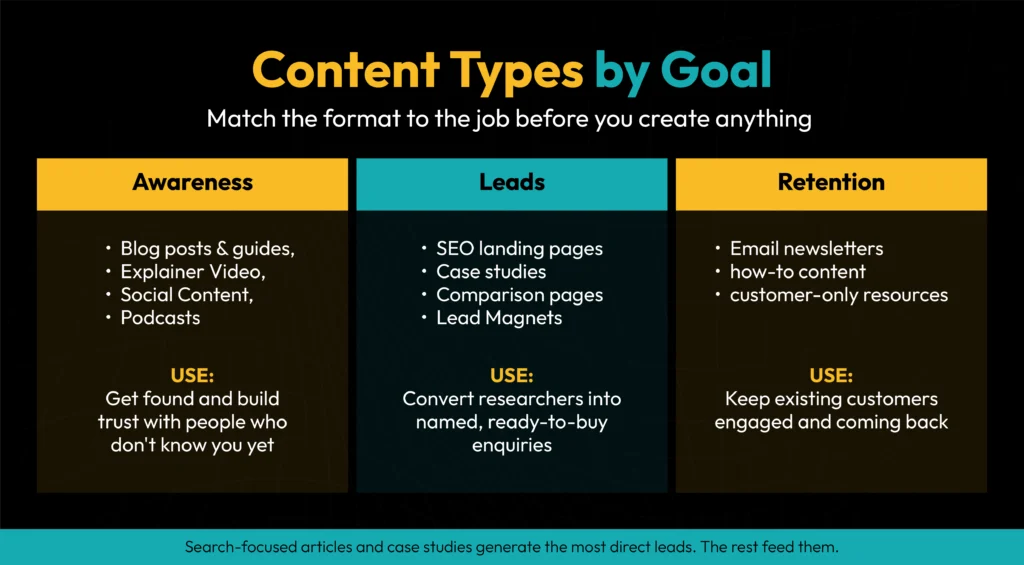
Plenty of formats fall under content marketing, but for generating leads, two do most of the heavy lifting: search-focused articles and case studies. Articles catch people while they’re still researching a problem; case studies hand them the proof they need to act.
The rest play supporting roles. Video and social media content build awareness at the top of the funnel, email keeps you in front of people who aren’t ready yet, and lead magnets turn anonymous readers into named contacts. The mistake almost everyone makes is spreading thin across all of them at once. One format done properly beats five done badly.
How Does Content Marketing Generate Leads?
Three steps turn content into leads and missing either one stops the other two from working: a page reaches the right person, earns their trust, then gives them somewhere to go.
It Reaches Buyers Earlier Than Ads Can
Every sale has a trail of questions in front of it. Long before someone searches “accountant near me,” they search “do I need to file a confirmation statement.” Content lets you answer that first question months before a competitor pays to bid on the last one, and the click costs you nothing.
It Does the First Sales Call for You
People buy from businesses that have already helped them. A detailed, honest answer proves you understand the problem before anyone picks up the phone, so part of the selling is done by the time a reader reaches your contact form. Sales teams usually feel this as a jump in lead quality, not just volume.
It Keeps Producing After You Publish
This is the part paid ads can’t touch. An ad dies the moment its budget does, while a page that ranks brings in visitors every month at no extra cost. Over its life, one strong article can out-earn a whole quarter of ad spend.
Mapping Content to the Funnel: TOFU, MOFU, and BOFU
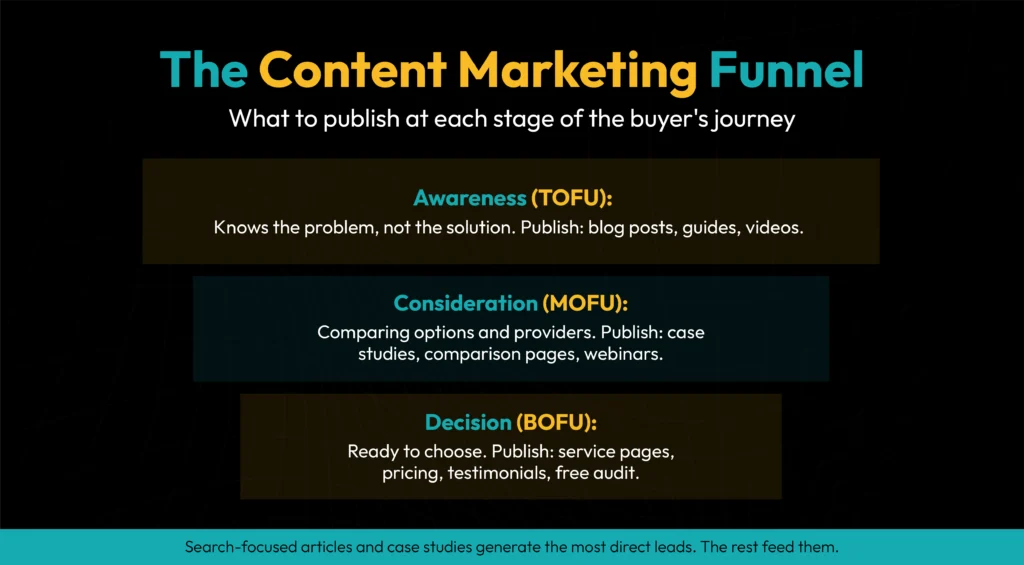
Not every reader is ready to buy, so not every piece should try to sell. The content marketing funnel matches what you publish to the three stages a buyer moves through, from first awareness (TOFU) to active consideration (MOFU) to the decision itself (BOFU).
At the top, people know they have a problem but not the solution, so educational guides and videos earn the first visit. In the middle, they’re comparing options, where case studies, comparison pages, and webinars prove you’ve solved this before. At the bottom, they’re ready to choose, and service pages, pricing, and a free audit remove the last bit of friction.
Most businesses pile everything into one stage, flooding the top with blog posts that never convert, or building bottom-of-funnel pages that nothing feeds. A funnel only works when all three stages are covered and internal links carry the reader down it.
Content vs Paid Ads: What Each One Buys You
The honest split is simple. If you need leads this month, run paid ads; if you want leads that get cheaper every month, build content. The strongest strategies run both.
Paid search is fast and it scales with budget. A UK private-hire firm we manage cut its cost per booking from over £10 to as little as £3.09 once the account was rebuilt, then scaled to 70+ bookings at £4.80 each. The catch is that you rent the result: WordStream’s 2026 data puts the average cost per lead at $66.69, rising every year, and the leads stop the day you stop paying.
Organic content works the opposite way. It’s slower to start, but a page that ranks keeps producing after the spend ends, which is why we rarely tell a client to choose one over the other.
Building a Content Strategy That Earns Leads
A content strategy starts with one question: which questions are your customers asking that nobody answers well? Get that right and everything else follows. Five steps take you from there:
- Know whoyou’re writing for. Build a simple buyer persona: what they want, what they fear, and what they type into Google before they buy.
- Find the real questions.Mine Google’s “People also ask,” related searches, and Search Console for the exact wording your audience uses, then sort it by funnel stage.
- Map content to the funnel.Plan a mix of awareness, consideration, and decision pieces so you attract and convert at once, and put it on an editorial calendar so publishing doesn’t stall.
- Write something only you could write.Lead with the answer, then add the first-hand detail, data, or opinion a competitor can’t copy.
- Distribute and repurpose.Promote each piece by email and social, and turn one strong guide into a video, a carousel, and a case study, so the research works several times over.
The Only Content Metrics Worth Tracking
Most content reporting measures the wrong thing. Traffic and rankings feel like progress, but they pay no invoices. The number that matters is enquiries; everything else is a step toward it.
So track metrics in the order they lead to revenue. Rankings and impressions show your pages are climbing, and engagement shows the content answers the question people came for. Conversion rate and cost per lead show whether any of it turns into business. A page with great traffic and no conversion path isn’t marketing, it’s a hobby.
Why Most Content Earns Nothing, and What Google Rewards in 2026
Remember the 96.55%? Here’s what separates it from the content that ranks. In May 2026, Google published its first official guide to AI search, and its clearest instruction was about quality: it rewards what it calls non-commodity content, the kind an AI couldn’t assemble by averaging everyone else’s pages.
In plain terms, write what only you can write, the first-hand experience Google’s E-E-A-T standards reward. “Five tips for choosing an accountant” can be produced by anyone, including a machine, so it earns nothing. “What our clients paid in year one, and the three fees that caught them out” can’t be copied, because the numbers are yours. First-hand data, real results, and an honest opinion are now the line between content that gets cited and content that disappears.
Proof: How One Clinic Recovered on Content Alone
A Harley Street pain clinic came to us after a security incident wiped out its search visibility. Rather than buy its way back with ads, we rewrote its core pages as direct answers to the questions real patients ask. Within six months, patient traffic climbed from 119 to 278, average position rose from 54.1 to 23.3, and the rewritten pages started appearing in AI-generated answers, at no extra cost. We did the work once, and the results kept arriving.
Content, SEO, and AEO: Where Each One Does the Work
These three get muddled constantly, so here’s the clean division of labour. Content marketing creates the asset, the page worth finding. SEO makes that page findable in search, through site speed, Core Web Vitals, internal links, and authority. AEO, or answer engine optimisation, makes it quotable by AI engines like Google’s AI Overviews and ChatGPT.
You need all three, because each one fails without the others. Perfect SEO on a thin page has nothing to rank, and brilliant content on a broken site stays invisible. Content that isn’t built for extraction gets skipped by the AI answers now sitting above the blue links, and Ahrefs found the sites already earning the most organic traffic are the ones AI engines mention most.
The agencies still treating these as separate budgets are the ones quietly losing ground.
How Long Content Marketing Takes, and What It Really Costs
Plan for six to twelve months before content becomes a steady source of leads, and expect to pay mostly upfront. Anyone promising page-one rankings in weeks is selling a fantasy.
Ahrefs found only about 1.7% of new pages reach Google’s top ten within a year, and the average page sitting at number one is roughly five years old. That slowness sounds like bad news, but it’s your moat: a rival can outbid you on ads tomorrow, yet can’t outrank two years of content you’ve already banked.
On price, there’s no fixed rate. The Content Marketing Institute’s 2026 research puts content at around 26% of the typical B2B budget, its biggest single line item. The smarter way to read cost is per lead over time: a £600 article that brings two enquiries a month costs £25 a lead in year one and £12.50 in year two, because you only pay to make it once.
Hire an Agency, or Build It In-House?
It comes down to one question: who is going to do this every week? Launching a blog is easy; the results come from the ongoing work, researching questions, writing to rank, updating pages, and building the SEO and AEO foundation underneath.
A business with an in-house marketing team can run this itself. Most smaller teams can’t spare the hours or skills, and a stalled blog costs more in wasted effort than it saves. If you’re unsure content is the right move, our content marketing team will review what you’ve got, show you the gaps, and tell you straight whether it’ll generate leads. No buzzwords, just the thinking you’ve read here.
FAQs
What is content marketing in simple terms?
It’s publishing genuinely useful content, such as articles, guides, and videos, that answers what your customers are searching for, then turning that attention into enquiries. Instead of paying for every visitor the way you do with ads, you attract them by being helpful, and the content keeps working long after you publish it.
How long does content marketing take to generate leads?
Usually six to twelve months. Ahrefs found only about 1.7% of new pages reach Google’s top ten within a year, though sites with existing authority move faster. That slow build is also what makes content hard for competitors to copy once you’re ahead.
What is the most effective type of content marketing?
For leads, search-focused articles and case studies win, because they reach people who are actively researching and give them the proof they need to act. Video and social are better for awareness than for direct enquiries. Most businesses get the best return leading with written, search-optimised content.
What is the difference between content marketing and social media marketing?
Content marketing is the whole practice of using useful content to attract and convert customers, mostly through search. Social media marketing is one channel inside it, focused on reaching people on platforms like LinkedIn and Instagram. Social is strong for awareness, while search-focused content tends to drive more direct leads. Most strategies use social to amplify content that lives on your own site.
Do small businesses need content marketing?
Often they need it most, because it lets them compete on usefulness instead of ad budget. A small firm can’t always outspend bigger rivals on paid ads, but it can answer customers’ questions better and earn rankings that keep producing leads for free. The only real requirement is consistency over six to twelve months.
What is evergreen content?
Evergreen content stays useful long after you publish it, like a guide to a process that rarely changes, rather than news that dates in a week. It’s the backbone of content marketing because it keeps pulling in search traffic and leads for years with only light updates. One good evergreen piece is what turns a single article into a long-term asset.


