


The average person now actively uses around 6.5 social platforms every month. So it feels safe to assume your customers are scattered across all of them. That assumption sinks most small-business social media.
A business opens accounts on Facebook, Instagram, LinkedIn, TikTok and YouTube at once, posts everywhere for a month, then runs out of steam and wonders why none of it brought in customers. The problem is rarely which platform they picked. It is that they picked all of them.
“Go where your audience is” sounds sensible, but it never explains how to decide. This guide shows you how to read your audience, match each platform to a real goal, and commit to two or three channels instead of six.
It also covers what most guides skip. In 2026, buyers scroll, search, and increasingly ask AI engines like ChatGPT, Perplexity and Google’s AI Overviews which providers to use. That last habit changes how you choose.
❝ The best social media platform for your business depends on your audience and your goals. LinkedIn works best for B2B and professional services; Instagram and TikTok suit visual and consumer brands; Facebook stays strong for local businesses and community; YouTube builds long-term discoverability. Rather than being everywhere, choose two or three platforms where your customers are most active. ❞
TL;DR: Social media platforms for business
Stop trying to be everywhere. Pick the two or three platforms where your buyers already spend time and where you can post consistently. Depth on a few channels beats a thin spread.
Why the Right Platform Matters More Than Being Everywhere
Being selective is the whole game. There were around 5.79 billion social media user identities worldwide in April 2026, close to seven in ten people alive. But those are identities, not people, and one person often holds several.
Your audience is technically everywhere. That is exactly why “be everywhere” is poor advice for a business with finite time and budget.
Each platform is its own discipline, with its own format, audience and posting rhythm. So doing one well takes repeated effort.
Spread a small team across five and you get five half-built presences, none strong enough to be noticed. The businesses that see results pick a short list and go deep. That starts with knowing who you are trying to reach.
Start With Your Audience
Answer two questions before you compare a single feature. Where do your customers already spend their attention, and what mindset are they in when they get there? A platform’s size tells you almost nothing about whether your buyers are on it, or whether they are there to buy. Someone scrolling TikTok at midnight is in a different frame of mind from someone searching YouTube for a how-to.
You can answer this without guessing. Ask your customers how they found you.
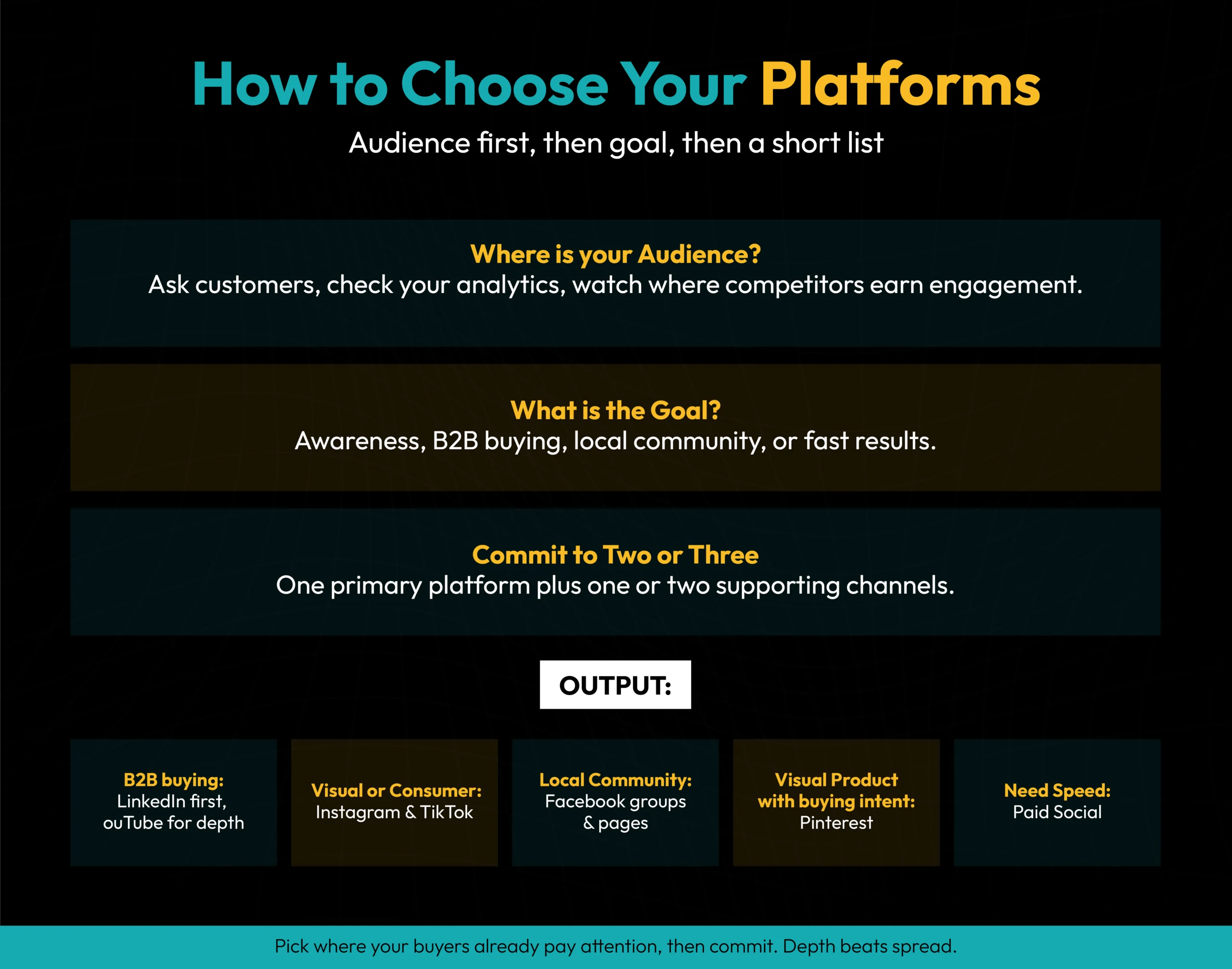
Check your own analytics for the channels that send traffic that converts, not just traffic that clicks. Watch where competitors earn real engagement, not just where they post. These three inputs usually point to one or two platforms, far more useful than a ranking of the biggest apps.
Match the Platform to Your Goal
A platform is a tool, and you pick a tool by the job. Many campaigns disappoint because the business expects sales from a channel built for awareness. Others chase reach from one built for high-intent search. So name your goal first and the choice gets simpler.
Awareness is a video job: TikTok, Instagram Reels and YouTube reach new audiences fastest. For B2B buying, LinkedIn is where decision-makers already are.
Local community still belongs to Facebook groups and pages. When you need results faster than organic posting can deliver, that is a job for paid social, where targeting does some of the audience-finding for you.
For businesses looking to accelerate results with targeted campaigns, our PPC Management London services can help you reach the right audience quickly and efficiently.
Platform Breakdown: Where Each One Earns Its Place
No platform is universally best. Each does one job better than the others, so it helps to judge them by who they reach and what they reward.
Facebook for Business
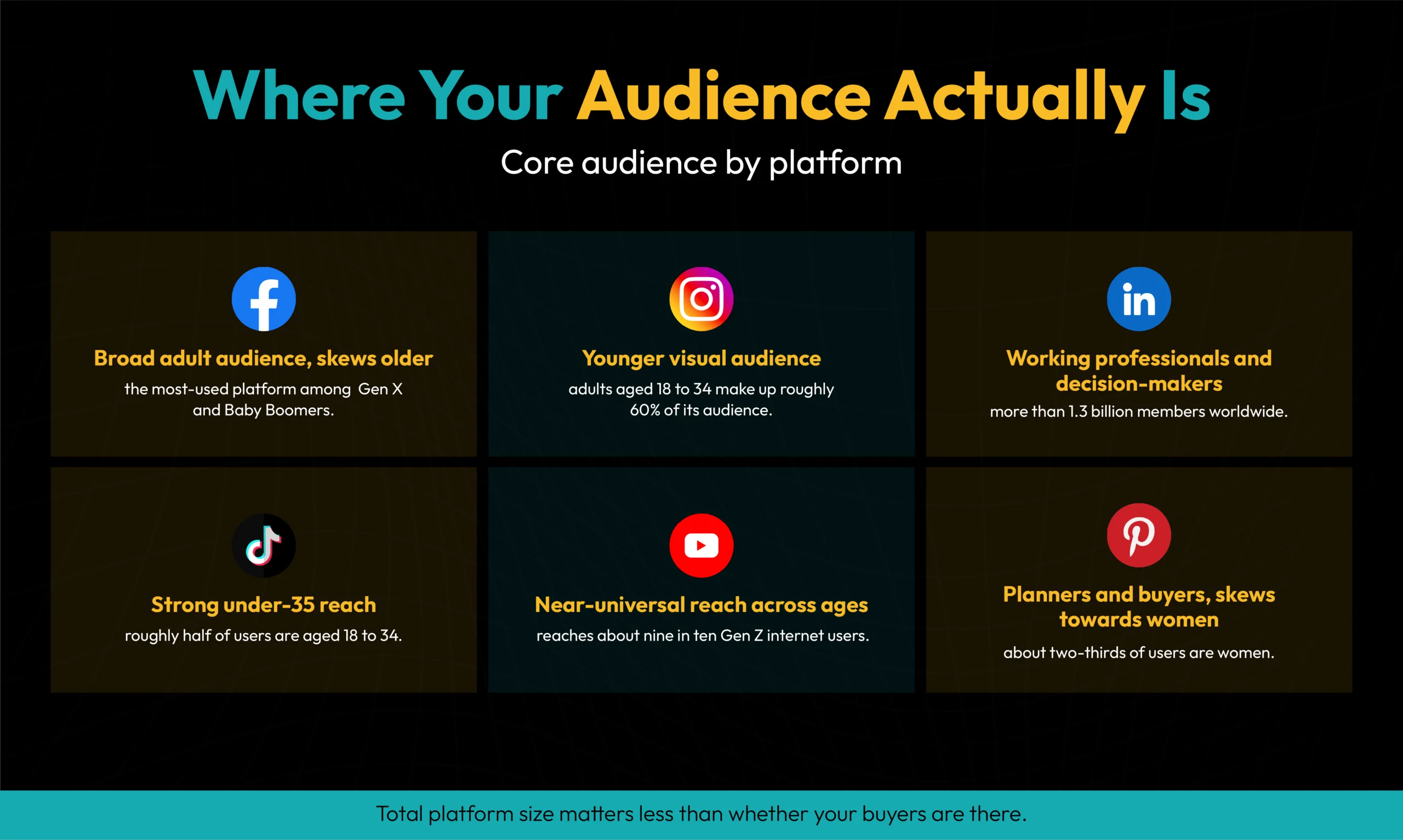
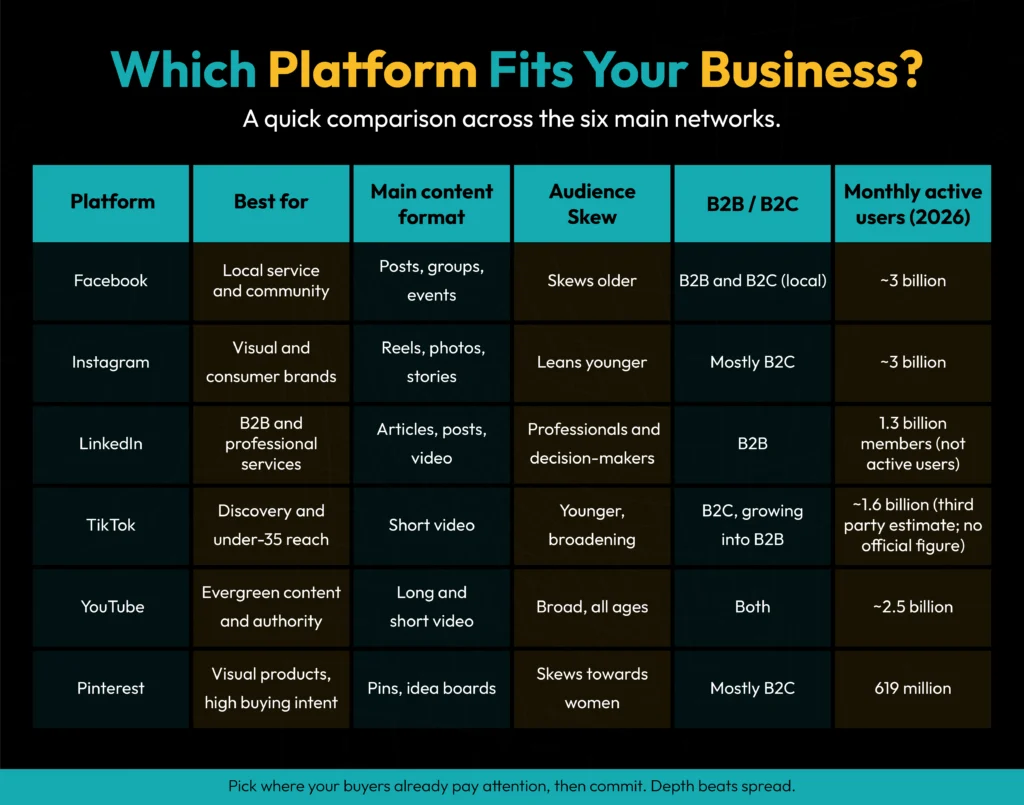
Facebook still has the broadest reach of the major networks, and its audience skews a little older. As a result, it is strong for local service businesses, community building and groups. If your customers are local adults who want to follow updates, ask questions and leave reviews, Facebook is hard to beat. It suits teenagers and fast-moving visual trends far less.
Instagram for Business
Instagram is built for visual storytelling. So it is a natural home for consumer brands, hospitality, beauty and food, and anything that photographs well. Discovery runs largely through Reels, and shopping features shorten the path from a post to a purchase. If your product is something people want to see, Instagram earns its place.
LinkedIn for Business
LinkedIn is the default platform for B2B, professional services and recruitment, with more than 1.3 billion members worldwide as of early 2026. Members means registered accounts, not people who log in each month. So treat it as reach potential rather than live audience.
Buyers research suppliers there and decision-makers read industry thinking there, so a steady presence builds credibility. If you sell to other businesses, LinkedIn is usually the first platform to commit to. But it rewards substantive, consistent posting, and a half-updated company page does nothing for you.
TikTok for Business
TikTok works as much like a discovery engine as a video app. A small account can still reach a large audience off one strong video. It publishes no official global user figure, and third-party estimates put it at roughly 1.6 billion monthly active users in early 2026.
That reach skews young, which makes it especially good for audiences under 35. Adoption among smaller firms has climbed fast: the Small Business and Entrepreneurship Council found 33% of US small businesses were using TikTok by October 2025, up from 17% in September 2023. It rewards consistency and honesty over polish, so it suits businesses willing to show their work. It is usually the wrong room for a buttoned-up brand that cannot be informal.
YouTube for Business
YouTube combines the largest video reach with something the others lack: search. A useful video can keep being found for years. That makes it excellent for evergreen how-to content, demonstrations and authority-building. It asks more of you in production, so it works best when you can post steadily rather than in one burst.
Pinterest for Business
Pinterest works differently because people arrive in a planning and buying mindset. It reached 619 million monthly active users at the end of 2025, an all-time high, about two-thirds of them women. As a result, it carries high purchase intent for visual products such as home, fashion, food and weddings.
For the right product it is a quiet performer; for the wrong one it is an irrelevance. Test it only if what you sell is something people plan and buy visually.
B2B or B2C: Which Platforms Work Best?
The split between business and consumer buyers changes the shortlist more than anything else. A B2B company should use social media, but selectively. LinkedIn comes first, YouTube supports it with depth, and other channels are usually a distraction unless you have a specific reason.
LinkedIn gathers professional buyers and decision-makers in one place. That is why 40% of B2B marketers name it the most effective platform for lead generation in Content Marketing Institute’s 2026 research, ahead of every other social channel. Treat that as a reference point, not a guarantee for your sector.
For B2C, the choice depends on the product, not the buyer’s job title. Visual and lifestyle brands tend to do best on Instagram and TikTok.
Local and community businesses lean on Facebook. Products with clear visual appeal and buying intent suit Pinterest. The principle holds either way: pick the platform where your buyer already pays attention, then commit to it properly.
How Does AI Search Change Which Platforms You Choose?
AI search adds a newer reason platform choice matters in 2026. Buyers increasingly ask assistants like ChatGPT, Perplexity and Google’s AI Overviews for recommendations.
Those engines build their answers partly from public content, including what is on social platforms and what others say about you there. So a consistent, substantive presence on the right platforms makes your business easier to find, understand and cite, for people and AI alike. A thin presence spread across six channels does the opposite.
So the decision is no longer only about where humans scroll. It is also about where your business shows up when an AI is asked to recommend one.
Google’s own guidance is blunt that AI search rewards the same credible, well-structured content that already ranks, which we break down in our guide to Google’s AI optimisation guidance. Helping businesses get found in AI search is a core part of our SEO Services, combining technical optimisation, high-quality content, and authority-building strategies to improve visibility in both traditional and AI-powered search.
How Many Platforms Should Your Business Run?
For most small and mid-sized businesses, the honest answer is two or three: one primary platform where your core audience lives, plus one or two supporting channels. Feed the supporting channels by adapting content from the main one rather than creating everything from scratch. Because of that, quality stays high without burning out a small team.
Repurposing is what makes two or three platforms sustainable. One short video can become a Reel, a TikTok, a YouTube Short and a LinkedIn clip with light editing.
Running six with bespoke content for each causes the collapse described at the start. Fewer channels, posted consistently, almost always win. For a system to plan this, see our guide How to Build a Social Media Content Calendar.
A Focused-Channel Approach: One Client Example
The focus principle is easiest to see in a real result.
A Harley Street pain management clinic came to us after a security incident. Its website had lost visibility for the treatment searches that brought in patients. Rather than chasing every channel at once, we focused on the surfaces that would move the needle: technical SEO, content optimisation and AI search visibility.
Within six months, patient traffic rose from 119 to 278 visits and average search position improved from 54.1 to 23.3. Treatment pages regained visibility for important London searches, and the clinic’s content began appearing in AI-generated summaries.
That is one illustration, not a promise, and the channel was search rather than social. The lesson carries across regardless. Growth came from naming the few channels that mattered and investing in them consistently, not from spreading thin.
Get Expert Help Choosing the Right Platforms
The hard question is where your focus should go. If your time is split across platforms with no clear reason, performance gets inconsistent and hard to measure. The cause is usually platform selection, not execution.
Book a free social media strategy session. We look at your current position, your audience behaviour and your goals. From there we identify the two or three platforms that actually support growth, and tell you where not to spend your time.
FAQs
Which Social Media Platform Is Best for a Small Business?
There is no single best platform; it depends on your audience and your goal. Local service businesses often do well on Facebook, visual and consumer brands on Instagram or TikTok, and B2B firms on LinkedIn. For most small businesses, two or three platforms where your customers already spend time beat trying to cover them all.
Is LinkedIn or Instagram Better for B2B?
For B2B, LinkedIn is almost always the stronger choice. It gathers professional buyers and decision-makers, and it is built around business context. That makes it better for quality leads and authority. Instagram can support a B2B brand’s culture and recruitment, but it rarely drives B2B sales the way LinkedIn does.
How Do I Know Where My Target Audience Spends Time Online?
Start with three sources. Ask your customers how they found you and where they spend time. Check your analytics for the channels that already send converting traffic, and look at where competitors earn real engagement rather than just where they post. Together these usually point to one or two platforms.
Can One Person Manage Multiple Social Media Accounts?
One person can usually manage two or three platforms, as long as they plan content ahead and repurpose it across channels. Trying to run five or six accounts alone tends to lead to inconsistency, and that is when results stall. The limit is rarely the number of logins; it is the time to do each one well.
How Much Does Social Media Marketing Cost?
It varies with whether you work in-house or with an agency, how many platforms you run, and whether you pay for ads. The biggest cost is usually time and consistency, since the platforms are free to post on. Paid social adds a budget you control on top.
What Is the Best Time to Post on Social Media?
There is no universal best time; it depends on your audience and platform. Use your own analytics to see when your followers are active, then post around those windows. That beats any generic “best time” chart.


