
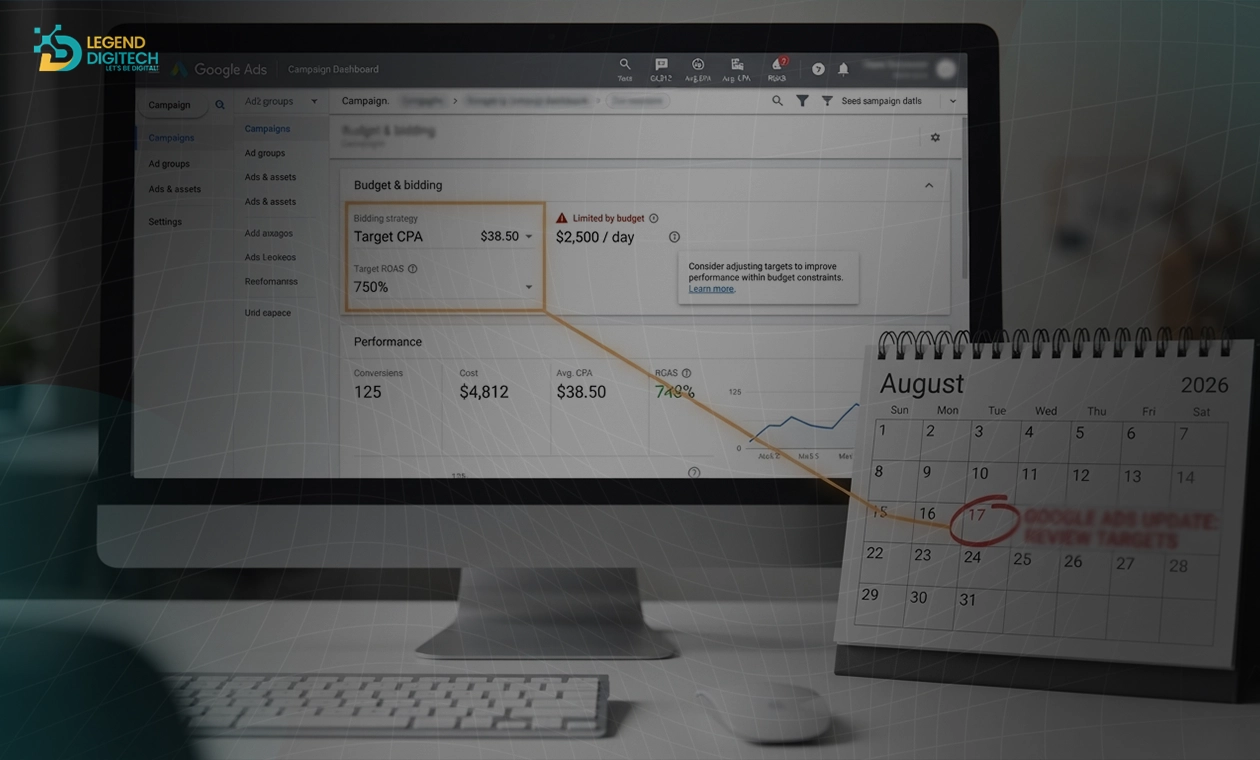


Review your budget-limited, target-based campaigns before Google Ads changes how it optimises them on 17 August 2026.
Campaigns that have been delivering below their Target CPA or Target ROAS will move towards the target instead. If yours is hitting £20 against a £40 target, it’ll start delivering closer to £40. Google has confirmed it won’t lower anyone’s target automatically.
What Changes on 17 August 2026
Until the change takes effect, budget-limited campaigns using target-based bidding can deliver below their stated Target CPA or Target ROAS. According to official Google Ads documentation, from 17 August 2026, these campaigns will perform more consistently towards your target. That holds even when your budget changes.
Google’s own example, adapted to pounds for a UK audience, makes this concrete. A campaign with a £10 Target CPA that’s been achieving £5 will move closer to £10 after the change. If you want to hold £5, you’ll need to enter £5 as the target.
The change only affects the bidding system. Google has confirmed the auction rules stay the same.
Which Campaigns Are Affected
The change applies only to campaigns constrained by budget. If your campaigns have budget headroom, they’re not affected.
| Campaign type | Status from 17 August 2026 |
|---|---|
| Search, Shopping, Performance Max, Demand Gen and Travel | Affected |
| Hotel and Display | In scope, but already using the new bidding behaviour |
| App, Video reach and Video view campaigns (VVC) | Not affected; previous bidding behaviour continues |
Google’s FAQ on the bidding change confirms the update covers Target CPA and Target ROAS across those campaign types. It also covers Target CPC, but only for Demand Gen campaigns. That includes Demand Gen run through Search Ads 360 or Display and Video 360. Target Impression Share and manual CPC aren’t affected.
Portfolio bidding and shared budgets are included too. Make target changes at the portfolio or shared-budget level, not campaign by campaign.
Google notified accounts with a budget-constrained campaign in the 12 months before the notification, using an affected target-based strategy. Some accounts got an alert with no recommended target attached. That doesn’t mean they’re unaffected. It only means their data didn’t meet Google’s threshold for a recommendation.
What Advertisers Can Do
Google’s Bid Target Adjustment Tool has been live since 6 July 2026. Use it to review your budget-limited campaigns. The tool gives you 3 ways to set a target:
- Keep your current target if it’s still realistic
- Match it to recent performance, though conversion volume may dip unless you also raise budget
- Set a custom, margin-based target (for ecommerce, use product margin, not blended CPA)
Separately, you can change the bid strategy entirely in your campaign settings. Switching to Maximize Conversions or Maximize Conversion Value removes the target rather than setting one. CPA and ROAS will then float.
Check your account before 17 August, since each option affects spend and volume differently.
Points to Watch
Forecasting tools, including Performance Planner, may be less accurate from 17 to 31 August 2026 while the new behaviour settles. Treat forecasts from this window with caution.
Accounts with fewer than 7 conversions won’t get a recommended target. Google says the data behind them is too unpredictable.
Don’t add data exclusions or bid limits just because of this update. That can cause the swings it’s meant to prevent. Give a target 1 to 2 conversion cycles before judging results.
Review Your Account Before the Change
At Legend DigiTech, we’re reviewing budget-limited campaigns against advertisers’ current targets. We’re helping them check whether those targets still fit their business goals before the change lands. Our Google Ads PPC management covers ecommerce and B2B accounts too.
Book an account audit before 17 August 2026. We’ll flag which campaigns may be exposed and what to do next.