



For a year, agencies have sold “AEO” and “GEO” as new disciplines with new retainers, and marketing budgets have quietly moved to chase them. On 15 May 2026, Google ended most of that debate. It published its first official guide to optimising for generative AI search, and the headline is blunt: there is no separate playbook.
Most coverage so far just summarises what Google said. This covers what matters more: what the guide means for your site, and what to do this week.
In short: Google published its first official guide to optimising for generative AI search on 15 May 2026, titled “Optimising your website for generative AI features on Google Search” and housed in Google Search Central. Its core message is that SEO best practices remain the foundation for AI visibility, that “AEO” and “GEO” are not separate disciplines, and that optimising for generative AI search “is still SEO.” It covers non-commodity content, crawl accessibility, structured-data myths, and Google’s first guidance on AI agents.
TL;DR:
There’s no separate strategy for AI search. The same crawlable, credible, genuinely useful pages that rank in classic Search are what surface in AI Overviews and AI Mode. The only sharpened bar is for original, non-commodity content that an AI couldn’t assemble from everyone else’s pages.
What Is Google’s AI Optimisation Guide, and Why Does It Matter?
What the Guide Actually Covers (5 Official Areas)
The guide groups its advice into five areas: why SEO best practices stay relevant (AI features run on Google’s core ranking and quality systems); non-commodity content, the strongest content signal; technical access (crawling, rendering, page experience, media); the reality of structured data for AI; and a mythbusting section with Google’s first guidance on AI agents.
Why This Is Significant: Google’s On-the-Record, Permanent Position
Until now, the loudest voices on AI search were vendors, not Google. Search Relations figures like Gary Illyes and Cherry Prommawin had said at events that “GEO” and “AEO” needed no separate framework, but those were talks, not documentation. Writing it down turns opinion into a reference your clients and competitors can both cite.
The stakes are not small. Sundar Pichai told Alphabet’s Q2 2025 earnings call that AI Overviews had reached 2 billion monthly users across more than 40 languages, and that they drove over 10% more queries for the kinds of searches where they appear.
That scale has a cost on the other side of the click. SISTRIX, analysing more than 100 million German keywords, found that when an AI Overview appears the click-through rate for the top organic result falls from 27% to 11%, a drop of 59%. Ahrefs measured a 34.5% lower click-through rate for the top-ranking page across 300,000 keywords, rising to 58% in its December 2025 data. Those are clicks your best pages used to get, which is why the guidance below is worth acting on.
Is SEO Still Relevant for AI Search? Google’s Definitive Answer
Yes, and Google now says so directly. The guide states that AI features on Search are “rooted in our core Search ranking and quality systems,” which means the work that earns rankings is the same work that earns AI visibility.
How AI Overviews and AI Mode Rely on the Same Core Search Index
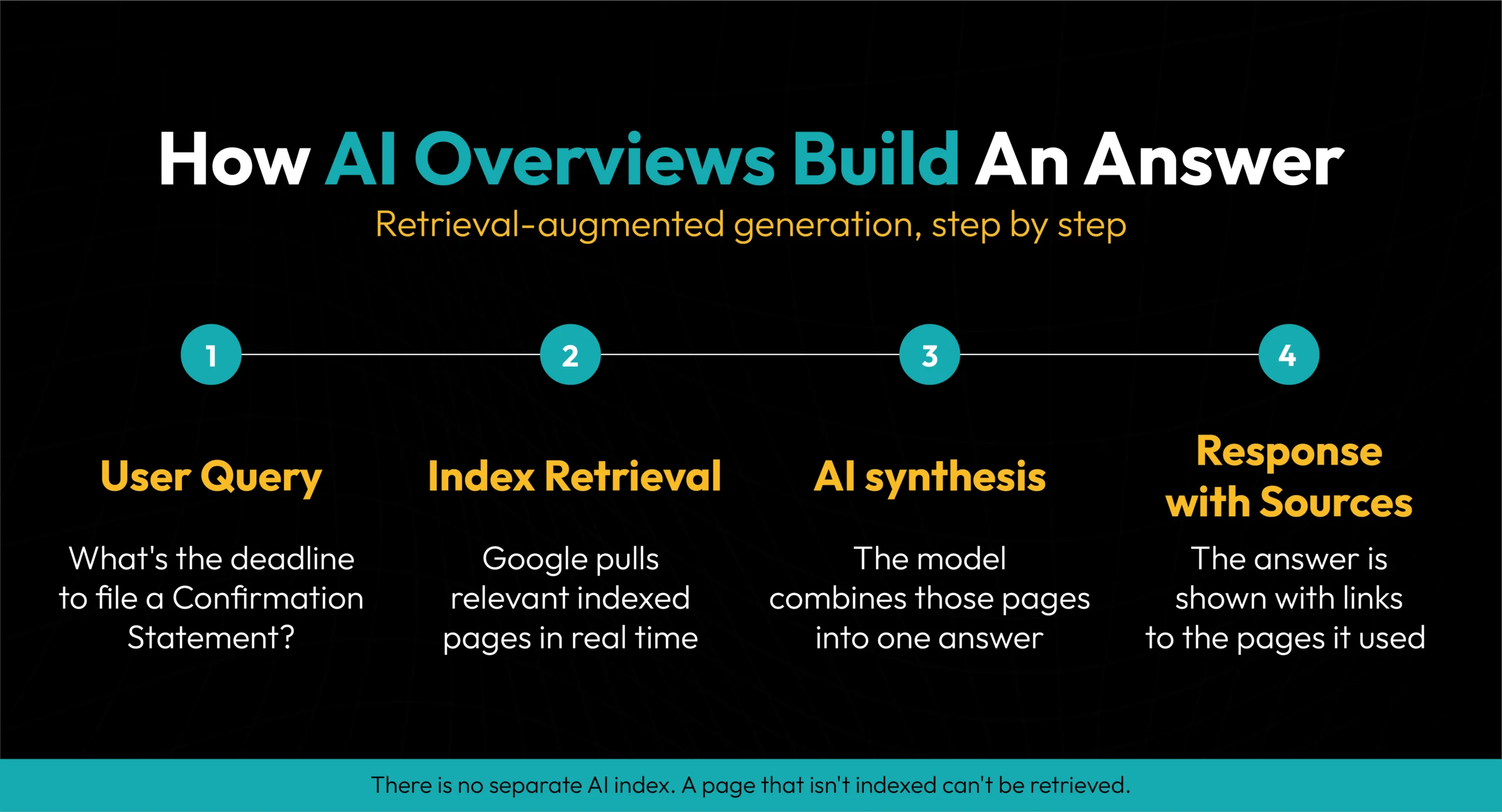
There is no separate AI index. AI Overviews and AI Mode pull from the same crawled, indexed pages that power blue-link results. The consequence is the single most important line in the guide: if Googlebot can’t crawl and index a page, that page cannot appear in an AI Overview or AI Mode. Crawlability is the entry ticket, not an afterthought.
What RAG Means for Your Content Strategy
AI Overviews use retrieval-augmented generation, or RAG. In plain terms, the model doesn’t answer from memory about your business. When someone asks a question, Google retrieves relevant indexed pages in real time, then synthesises an answer and links the sources it used. Say a UK business owner searches for a Companies House filing deadline: the model fetches indexed pages that cover it, lifts the answer, and cites them.
That changes what “good content” has to do. Your page has to be retrievable and extractable: indexed, clearly written, and structured so a specific answer can be lifted out cleanly. An insight buried in paragraph 14 is hard to retrieve; a clear answer near a clear heading is easy.
What Query Fan-Out Is, and Why You Should Not Chase Long-Tail Variations for It
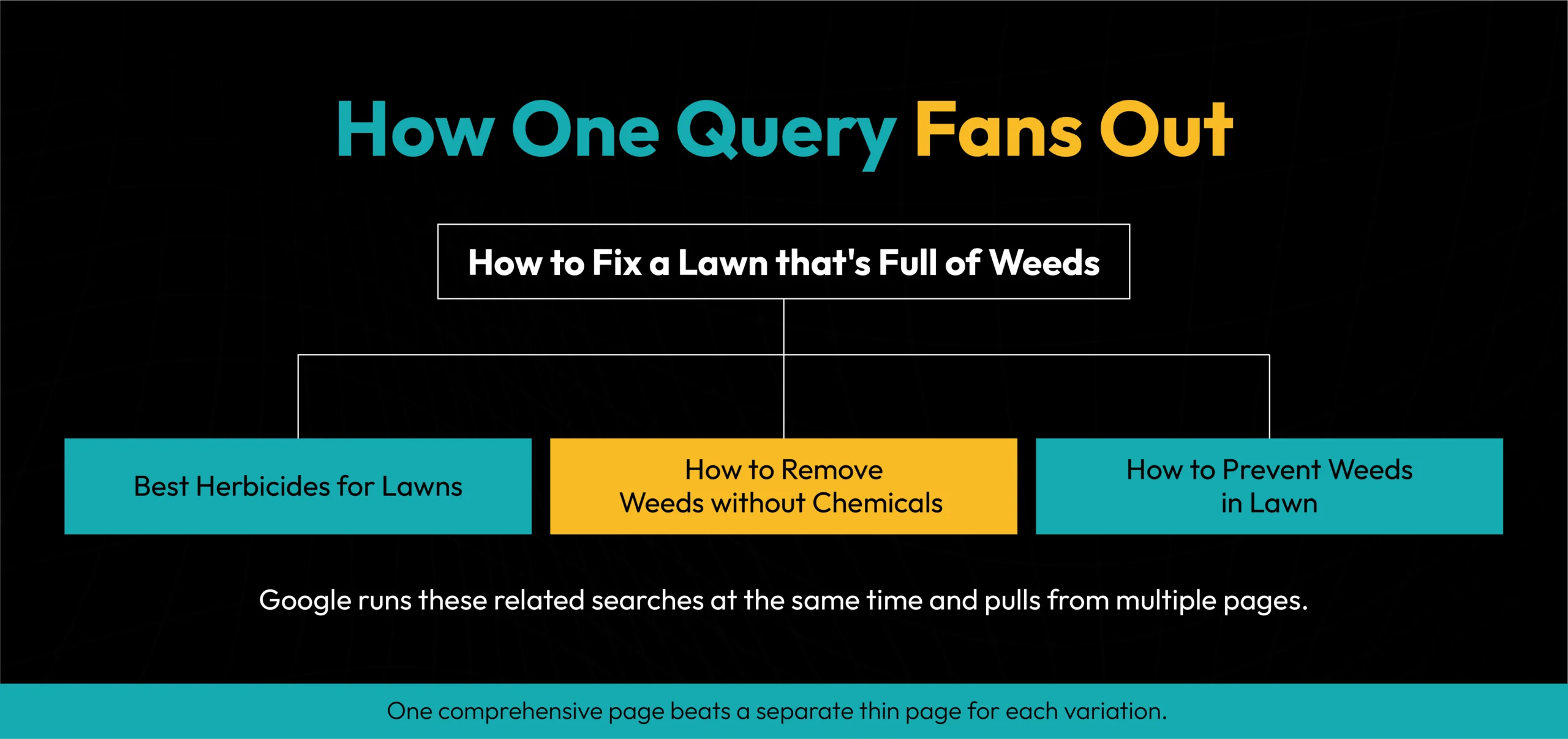
Query fan-out is how AI Mode handles a question with depth. Google takes one query and generates several related sub-queries, runs them at once, and pulls from multiple pages. Google’s own example: “how to fix a lawn that’s full of weeds” fans out into “best herbicides for lawns,” “remove weeds without chemicals,” and “how to prevent weeds in lawn.”
Here is where many people get it wrong: they spin up a separate thin page for every fan-out variation. Google explicitly warns against it, because producing pages at scale to manipulate AI responses violates its scaled content abuse policy. The systems already understand synonyms and intent, so they can connect a query to your content even when the wording differs. One genuinely comprehensive page beats a dozen near-duplicates, and it keeps you out of spam-policy trouble.
AEO vs GEO vs SEO: Google Officially Settles the Debate
Google’s answer is that AEO and GEO are still SEO. The guide puts it plainly: “Optimising for generative AI search is optimising for the search experience, and thus still SEO.”
What AEO and GEO Actually Mean
AEO stands for answer engine optimisation and GEO for generative engine optimisation. Both terms describe the goal of showing up in AI-generated answers rather than only in blue links. The industry coined them; Google didn’t.
Why Google Says They Are Still SEO
Because the surface is the same underneath. AI features use the same crawl, index, ranking signals, and quality systems as classic Search. There is no second optimisation layer to buy your way onto.
What This Means Practically for Agencies and Businesses Paying for “AEO Services”
If a vendor is selling “AEO” or “GEO” as a separate retainer with its own deliverables, it’s fair to ask what’s in it that isn’t SEO. Much of what’s marketed as a new discipline is repackaged fundamentals: extractable answers, clean entity and topic coverage, technical health, and real E-E-A-T signals. Those are worth paying for. They’re also just SEO done well. At Legend DigiTech we’d rather a client understand that than pay twice for the same work under two names. You can see how that thinking shapes our SEO services rather than bolting on a buzzword.
The Most Important Signal: Non-Commodity Content (and How to Create It)
The content most likely to surface in AI search is content a model couldn’t assemble by averaging everyone else’s pages. Google calls this non-commodity content, and it’s where the guide draws its sharpest line.
Commodity vs Non-Commodity: Google’s Own Examples Explained
Google gives a clean pair. A piece titled “7 Tips for First-Time Homebuyers” is commodity content: it’s common knowledge that could come from any source and adds little a reader couldn’t find anywhere. A piece titled “Why We Waived the Inspection & Saved Money: A Look Inside the Sewer Line” is non-commodity: it carries first-hand experience, a specific decision, and a result no generic article would have.
The marketing equivalent is easy to picture. “10 social media tips for small businesses” is commodity. “We cut a client’s cost per lead by 38% by killing their best-performing ad: here’s why” is not.
Self-Audit: 5 Questions to Test Whether Your Existing Content Is Commodity
Run any important page through these five questions. If you answer badly on most of them, the page is commodity, and it’s a candidate for a rewrite.
- Could a model write this section by averaging the current top 10 results? If yes, it adds nothing.
- Does itcontainfirst-hand data, a real result, or a decision only your business could report?
- If you stripped the logo, would it be indistinguishable from a competitor’s page?
- Does it take a clear point of view, or onlysummarisethe consensus?
- Is there a specific number, name, date, or example that a generic articlewouldn’thave?
How to Add a Unique Point of View to Pages That Are Currently Generic
The fixes are concrete. Add proprietary data or anonymised client outcomes, name your method instead of describing a vague process, take a defensible stance where the consensus is lazy, and replace general advice with a specific example you actually saw. Each move strengthens the “experience” half of E-E-A-T, the part Google’s systems can’t manufacture on a competitor’s behalf.
Technical SEO for Generative AI Search: What Still Matters
Getting crawled, rendered, and indexed is the price of entry for AI visibility, and the fundamentals that deliver it haven’t changed. The guide adds nothing AI-specific here, which is the point. The old checklist still rules.
Crawlability, JavaScript Rendering, and Page Access
Googlebot has to reach your pages and render them. Standard JavaScript SEO applies: don’t hide important content behind scripts that never render for the crawler. On large sites, manage crawl budget and cut duplicate pages, because pages that never get crawled never enter the index AI features draw from.
Page Experience and Core Web Vitals
Pages should render well on every device, load quickly, and present a clear content hierarchy. Core Web Vitals still matter as a quality input, though they won’t rescue weak content.
Images, Video, Shopping, and Local Content in AI Features
AI features surface visual, shopping, and local results too. Follow Google’s image and video SEO documentation so media can be understood and shown. For local and ecommerce visibility, keep your Google Business Profile accurate and your Merchant Center feeds clean, because those feed the AI experiences.
Structured Data: What It Does and Does NOT Do for AI Visibility
This is where a lot of money gets wasted. The guide is explicit: “Structured data isn’t required for generative AI search, and there’s no special schema.org markup you need to add.” Schema still earns rich results in classic Search, so keep it accurate and relevant. Just don’t invent markup or inflate it hoping to trigger an AI mention, because it won’t.
Mythbusting: 6 Tactics Google Says You Can Safely Ignore
Vendors are selling specific tactics that simply don’t work for AI search, and the guide names them. Here’s each one, what Google actually said, and what to do instead.
llms.txt: Necessary or Not? (Google’s Answer Is No)
Google says “you don’t need to create new machine readable files” to appear in generative AI search. Googlebot might discover an llms.txt file, but it treats it like any other text file with no special indexing path. Skip it.
Content “Chunking” Specifically for AI
There is, in Google’s words, “no requirement to break your content into tiny pieces for AI to better understand it.” Write for humans and structure logically. Clear sections help readers and extraction at the same time, without any artificial fragmenting.
Special Schema Markup to Trigger AI Responses
No schema type unlocks AI features, as covered above. Use structured data for rich-result eligibility and accuracy, and stop there.
Chasing Inauthentic Brand Mentions and Links
Google warns that “seeking inauthentic mentions across the web isn’t as helpful as it might seem.” Spam systems catch manufactured placements. Mentions earned through genuine quality and real participation in your field are what carry weight.
Keyword-Stuffing to Capture Fan-Out Queries
Building a separate page for every fan-out variation to game AI responses falls under the scaled content abuse policy. Consolidate into strong, comprehensive pages instead of fragmenting into thin ones.
Blocking Googlebot to Manipulate AI Feature Inclusion
You can’t keep classic rankings while blocking the AI features, because they share one crawler and one index. Block Googlebot and you disappear from both. The Google-Extended token only controls whether your content trains Gemini; it has no effect on whether you appear in AI Overviews or AI Mode.
If you want a page kept out of AI Overviews specifically, the only lever available today is the nosnippet or data-nosnippet directive, and a full nosnippet also strips your normal search snippet. Google said on 28 January 2026 that it’s exploring a cleaner opt-out, but it isn’t live yet.
AI Agents: What Google’s New Guidance Means for Your Site
The guide includes Google’s first official word on agentic browsing, where an AI acts on a page for a user rather than just reading it. For most sites this isn’t urgent yet, but it’s cheap to prepare for.
What AI Agents Do and How They Access Web Content
AI agents navigate pages and complete tasks, from comparing products to filling forms. Google points to the emerging Universal Commerce Protocol and to an agent-friendly UX guide on web.dev for sites that want to be ready. The thrust is that agents need pages they can read and act on reliably.
What to Audit Now to Ensure Your Pages Are Agent-Accessible
The checklist looks a lot like accessibility done properly: a clean DOM structure, valid accessibility trees, predictable layouts, fast load times, and forms or actions that work without brittle JavaScript. The same hygiene that helps a screen reader helps an agent complete a task. For transaction and booking pages especially, that’s worth auditing now.
Your 7-Step AI Search Optimisation Action Plan
This is the part the news summaries skipped: the concrete sequence, mapped to the guidance above.
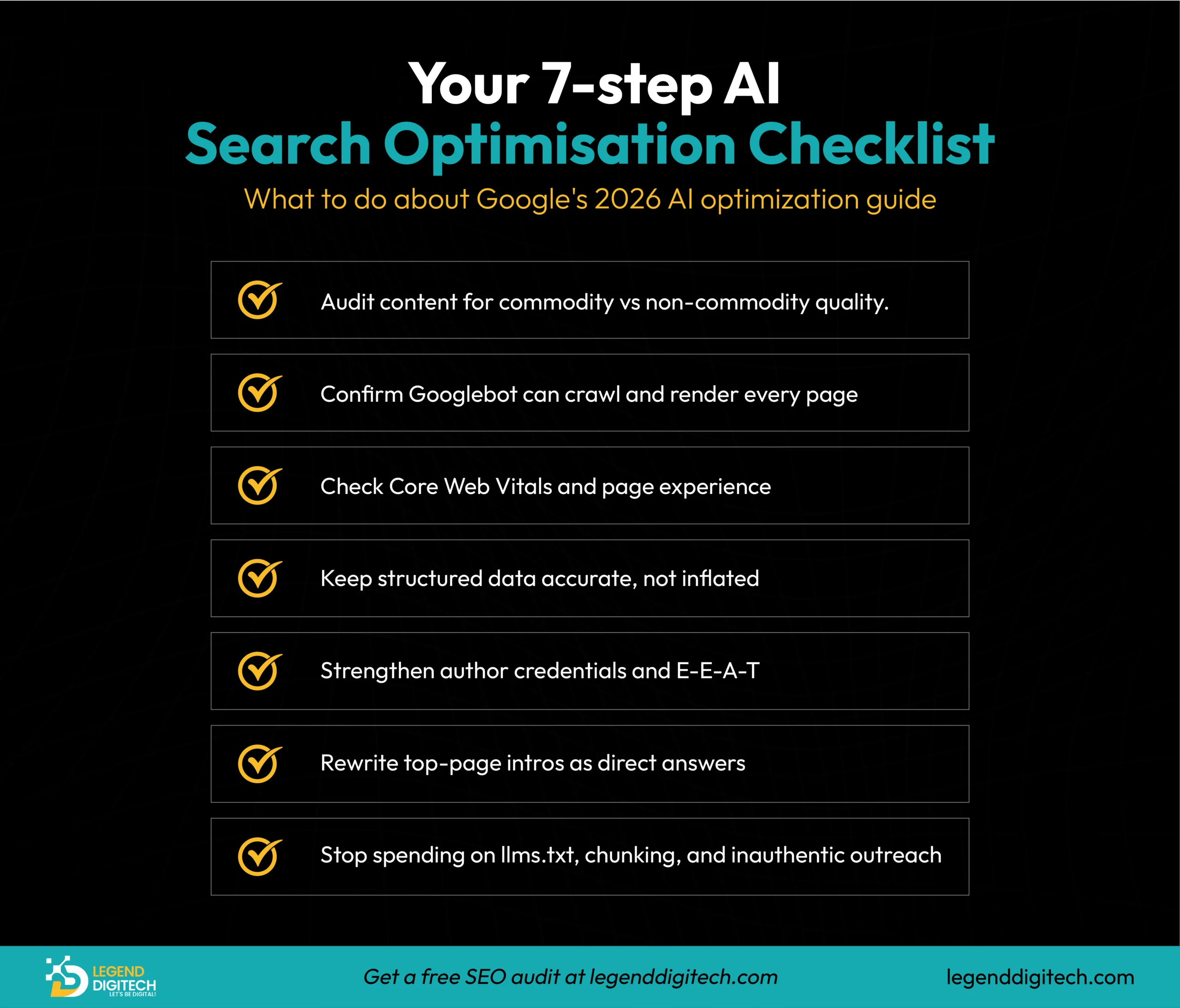
- Audit your content for commodity vs non-commodity quality.Run your priority pages through the 5-question test and flag the ones a model could write on its own.
- ConfirmGooglebot can fully crawl and render your pages. No AI index exists, so crawlability is non-negotiable. Check coverage in Google Search Console.
- Check Core Web Vitals and page-experience scores.Fix the pages that load slowly or shift around on mobile.
- Make structured dataaccurate, not inflated. Keep schema valid for rich results and resist adding markup purely for AI.
- Add or strengthen author credentials and E-E-A-T signals.Real authors, real experience, visible expertise.
- Rewrite intros on your highest-value pages as direct answers.Identify the pages you most want cited and put the answer near the top where RAG can lift it.
- Stop spending on llms.txt, chunking, and inauthentic outreach.Move that budget to steps 1 and 5, where it actually moves the needle.
We’ve seen this play out directly. When a Harley Street pain clinic came to Legend DigiTech after a security incident wrecked its search visibility, the recovery ran on exactly the fundamentals above: technical cleanup, clearer content structure, and informational sections written as direct answers to real patient questions. Within six months, patient traffic rose from 119 to 278 and average position improved from 54.1 to 23.3. The clinic’s content also began appearing in AI-driven summaries for question-based searches: the crawlable, credible pages that recovered its rankings are the same ones that earned the AI citations.
Want the short version to keep on your desk? Get a free SEO audit and see how your content scores against Google’s new AI standards.
FAQs
What is Google's AI optimisation guide?
It’s Google’s first official guide to optimising for generative AI search, published on 15 May 2026 in Google Search Central. It confirms that SEO best practices still apply, that AI features run on Google’s core index and ranking systems, and that “AEO” and “GEO” are not separate disciplines. It also covers non-commodity content, technical access, and structured-data myths.
Does AEO or GEO replace SEO?
No. Google states that optimising for generative AI search is still SEO, because AI Overviews and AI Mode use the same index and ranking signals as classic Search. AEO and GEO describe the goal of appearing in AI answers, not a separate method you need to buy. The work that earns rankings is the work that earns AI visibility.
Do I need an llms.txt file to appear in AI Overviews?
No, you don’t. Google says there’s no need to create new machine-readable files to appear in generative AI search. Googlebot may find an llms.txt file, but it gets no special treatment or preferred indexing.
What is non-commodity content, and why does Google prefer it?
Non-commodity content carries first-hand experience, original data, or a specific point of view that a model couldn’t synthesise from everyone else’s pages. Google contrasts a generic “7 tips” list with a specific first-hand account of a real decision and result. Because it’s harder to replicate, it’s more valuable in AI answers.
What is query fan-out in Google AI search?
Query fan-out is when Google generates several related sub-queries from a single question, runs them at once, and pulls from multiple indexed pages. For “how to fix a lawn that’s full of weeds,” it might fan out to herbicides, chemical-free removal, and prevention. You shouldn’t build a separate thin page for each variation, since that breaches Google’s scaled content abuse policy.
What is retrieval-augmented generation (RAG) in the context of SEO?
RAG means the model retrieves relevant indexed pages at query time and synthesises an answer with source links, rather than answering from memory. For your site, that means a page must be indexed and easy to extract from to be retrieved at all.
Has Google's core ranking guidance changed for 2026?
No. The guide confirms that existing SEO best practices still apply and adds clarity on how AI features work, not a new ranking system. The main new emphasis is on original, non-commodity content.
How do AI agents affect my website's SEO?
AI agents browse and act on pages for users, so the early guidance is about access rather than ranking. Keep your DOM clean, accessibility trees valid, layouts predictable, and pages fast. That standard accessibility hygiene also lets an agent complete tasks like booking or buying without breaking.


